The Unthinkable: Is a US-China War Possible? US War Ships in the South China Sea. A New Era of “Great Power Competition”

The US is waging undeclared war on China by other means — aiming to undermine its growing prominence on the world stage.

Pompeo falsely calling China’s new national security law “an affront to all nations,” his endless war of words on the country, Trump’s FCC designation of Chinese tech giants Huawei and ZTE as “national security threats,” and other hostile US actions against Beijing are a prescription for continued deterioration of bilateral relations or something worse — possible direct confrontation ahead.

Earlier this year, Trump regime war secretary Esper threatened China, saying:

The US is engaged in a new “era of ‘great power competition,’ and that means we need to focus more on high intensity warfare going forward.”

Indicating that greater numbers of US forces will be deployed in the Asia/Pacific, he said Washington’s “longterm challenges are China No. 1 and Russia No. 2,” adding:

“(W)hat we see happening out there is a China that continues to grow its military strength, its economic power, its commercial activity, and it’s doing so, in many ways, illicitly (sic) — or it’s using the international rules-based order against us to continue this growth, to acquire technology, and to do the things that really undermine our sovereignty (sic), that undermine the rule of law (sic), that really question (its) commitment to human rights (sic).”

This presentation PROOVES WITHOUT DOUBT that America is in for a major fight that will put you and your family in the firing line, literally… So make sure you watch this presentation while it’s still online…

Omitted from his remarks was that China, Russia, and other nations on the US target list for regime change pursue world peace, stability, and cooperative relations with other countries, confrontation with none.

Their aims are polar opposite how the US operates, seeking dominance over other nations by pressure, bullying, or brute force.

It’s waging permanent wars on targeted countries by hot and/or other means.

The latter rages against China, risking things turning hot by accident or design.

What’s unthinkable between two nuclear powers is possible, a frightening prospect for what could lie ahead.

Ramping up US military forces in the Asia/Pacific to “compete with China” is a euphemism for escalating cold war that could turn hot.

In January 2019, Chinese President Xi Jinping said

“(a)ll military units must correctly understand major national security and development trends, and strengthen their sense of unexpected hardship, crisis and battle,” adding:

“The world is facing a period of major changes never seen in a century, and China is still in an important period of strategic opportunity for development.”

Xi ordered stepped up military training and exercises, saying China’s armed forces must “prepare for a comprehensive military struggle from a new starting point”, adding:

“Preparation for war and combat must be deepened to ensure an efficient response in times of emergency.”

The threat to China’s national security from the US is ominously real.

Provocations by Washington could escalate to something more serious.

On July 3, Trump regime Office of Trade and Manufacturing Policy director Peter Navarro falsely claimed the following:

“I want everybody right here today, as the day before America’s Independence Day, to understand where this virus started — with the Chinese Communist Party that is making us stay locked in our homes and lose our jobs (sic).”

“They spawned the virus (sic). They hid the virus (sic). They sent hundreds of thousands of Chinese nationals over here to seed and spread the virus (sic),” adding:

“While they were preventing any domestic travel from Wuhan to Beijing or Shanghai, locking down their transportation network, they freely sent hundreds of thousands of Chinese nationals on aircraft to go around the world” to spread the virus (sic).”

Not a shred of evidence backs Navarro’s outrageous claim.

Polar opposite it true. China helped and continues to help scores of nations combat COVID-19 outbreaks, including by supplying personal protective equipment (PPE).

A previous article suggested that the SARS-Cov-2 virus is a made-in-the-USA bioweapon.

In all its preemptive wars on nations threatening no one, the US uses chemical, biological, radiological, and other banned weapons.

In March, Pompeo called COVID-19 “a live (military) exercise.”

Was it a Freudian slip or a damning revelation? Trump reportedly responded to his remark, saying:

“I wish you would have told us.”

The Trump regime’s misnamed “Wuhan virus” most likely originated in a US biolab, Fort Detrick, MD the likely facility.

Evidence shows that the SARS-Cov-2 virus that produces COVID-19 disease originated in the US last summer.

Even SWAT Teams are Helpless Against This – WATCH THIS VIDEO and you will find many interesting things!

SvMD-In-Article-New-Cover

It showed up in Europe before reported outbreaks in China last December.

US stoked tensions with China are at a fever pitch.

In late June, National Institute for South China Sea Studies president Wu Shicun said Sino/US distrust led to hundreds of “track one” intergovernmental communication channels shutting down.

A separate report indicated that communications between the Pentagon and China’s military declined markedly since 2018.

Wu noted that “the risks of conflict are rising, especially after the near-collision between the USS Decatur guided-missile destroyer and China’s destroyer the Lanzhou in September (2018) in the South China Sea.”

At the time, Beijing blamed the US for what it called “provocative actions.”

Deteriorating bilateral relations continue, mutual distrust increasing.

US South China Sea military exercises close to its waters are highly provocative.

The presence of US forces in parts of the world not its own heighten tensions.

In the South China Sea, they risk confrontation between two nuclear powers.

A breakdown in Sino/US communications increases the danger.

For the first time since the pre-1990 Cold War ended, three US carrier groups are patrolling Asia/Pacific waters.

The US Pacific Fleet said its forward-deployed submarines are conducting operations in the Western Pacific.

On Saturday, the Wall Street Journal reported that USS aircraft carriers Reagan and Nimitz, along with four other US warships, are holding “some of the (Pentagon’s) largest exercises in recent years in the South China Sea,” beginning July 4.

Citing US officials, their purpose is “to challenge what they called Beijing’s unlawful territorial claims (sic).”

It’s the first time since 2014 that two US carriers and other warships conducted South China Sea drills close to Chinese waters.

USS Ronald Reagan strike-force commander Admiral George Wikoff said the following:

“We’re really operating at a higher tempo and simulating a higher end of combat power than we would typically do in a shorter length exercise,” adding:

“We’re flying around the clock, hundreds of sorties a day in a 24-hour period.”

Reportedly Chinese military officials haven’t met with their US Indo/Pacific Command counterparts since 2017.

While it’s unclear where things are heading, the risk of a clash between two nuclear super-powers is ominously real.

Instead of stepping back from the brink in the Asia/Pacific, the US continues to heighten tensions — risking confrontation with a nation able to hit back hard if attacked.

A Final Comment

Addressing the issue of whether Sino/US trade ties can avert hot war last May, China’s Global Times said the following:

“(I)n light of relentless hostility from Washington, there is…a sobering realization among many in China that the bilateral relationship with the US has reached a point of no return from which rivalry and confrontation will overtake constructive engagement as the US’ desperation to cling onto its remaining global strength and influence will only intensify with the rapid rise of China.”

Whether this causes continued political, economic, technological, and trade rivalry alone or heads toward military confrontation ahead remains unknown.

If you’re interested in learning more old remedies, you should read The Lost Book Of Remedies.

Lost Book of Remedies pages

The physical book has 300 pages, with 3 colored pictures for every plant and for every medicine.It was written by Claude Davis, whose grandfather was one of the greatest healers in America. Claude took his grandfather’s lifelong plant journal, which he used to treat thousands of people, and adapted it into this book.

Lost Book of Remedies cover

Learn More…

The Economic Holocaust… Bankrupting the Nation. “The Shut-In Economy”

When we take into consideration $144.6 trillion in US Unfunded Liabilities, $20.4 trillion in Social Security Liability, and $31.6 trillion in Medicare liability, the nation lingers on the precipice a total collapse.

For all the uncertainties the COVID-19 pandemic poses to the world, especially in the US, one thing seems evident.  Our neoliberal capitalist civilization has proven itself to be unprepared for unexpected crises and catastrophes. For decades, the US has been falling behind other developed nations to infuse economic resiliency in society. Not only has the American medical system and federal health agencies been shown to be naked, we are also discovering we cannot rely on epistemological statistics and computer modeling alone to account for our flawed health policies.

Aside from the pandemic’s toll on people’s lives, there is also its impact upon the national economies and the global economy at large that is barely being discussed in any depth. Rather, hopes and wishes are being directed towards life returning to normal. We are expected to believe that our addiction to unconscionable consumerism will return, employment will rise and the American dream can again be mentally photo-shopped on the horizon. In short, we are persuaded that the comfort of our illusions and denial of harsh realities will return.  However, if a past Nobel laureate of economics, Joseph Stiglitz, is correct, then “if you leave it to Donald Trump and Mitch McConnell we will have a Great Depression.” Likewise, former Federal Reserve chair Jenet Yellen has also warned that the 30% GDP decline is leading us towards Depression. In fact, we may already be there.

As of today, the federal government has guaranteed $5.2 trillion dollars to keep the economy afloat as a depression worse than 1932 looms overhead. Some economists believe that this massive bailout is insufficient and upwards to $10-15 trillion may be necessary.  In 2008, with one broad stroke the Obama administration rescued Wall Street.  What was believed to be just the TARP bailout of $700 billion was in fact over $4 trillion worth of outlays, including TARP and other FED and Treasury expenditures.  The Levy Institute at Bard College calculated the outlays may have been as high as $29 trillion, a number the Sanders’ campaign had quoted.

Obama’s bailout was to assist the incompetency and corruption of Wall Street and the financial industry. Today it is a submicroscopic organism, approximately 120 nanometers (one nanometer is one billionth of a meter or about 20 oxygen atoms lined up), that threatens the financial well being of most Americans.

However before the COVID-19 reached our shores, the US was already in a horrible debt crisis.

Fiscal conservatives are angered that the US National Debt has reached $24.5 trillion while at the same time adamantly ignoring that the US Total Debt now hovers above $77 trillion. Neither party shows concern about Americans’ increasing personal debt (mortgage, credit card, auto, student loans, etc), nor the rise in corporate, state and city debts.

When we take into consideration $144.6 trillion in US Unfunded Liabilities, $20.4 trillion in Social Security Liability, and $31.6 trillion in Medicare liability, the nation lingers on the precipice a total collapse.

Before the pandemic, Trump boasted an unemployment level as low as 3.6 percent. But in the US, there are different ways to calculate unemployment figures. There is the official figure (U-3) that Wall Street and presidential administrations rely upon and then a more realistic statistic or U-6 that includes those underemployed and those only marginally attached to the work force.

Before the pandemic the “real” or U-6 employment was 6.9 percent.  Finally there is the shadow statistic, which adds the millions of Americans who have dropped out of the work force because their benefits ceased or because they are homeless or unaccounted for by the Labor Bureau.  When those adjustments are made, the shadow unemployment is likely around 23 percent.

Now, unemployment is skyrocketing.  The most recent estimate is that over 26 million people lost work during the past month and, according to Fortune magazine, the official unemployment rate may be as high 18 percent. 

Consequently a more accurate unemployment figure would be approximately 32 percent or almost a third of population. This is far worse than at the height of the Great Depression when unemployment stood at 25 percent.

The dark side of American jobs has been decades of large layoffs, workers being replaced by automation, downsizing, corporate consolidation due to equity partnerships, mergers and off shoring of manufacturing. In addition, tens of thousands of foreign professionals have received work visas and are eager to take the place of middle seniority positions in firms for lower salaries and without full benefits.  The system is so corrupt that the millions of people who work full time for less than a living wage are completely ignored. Hence most Americans are deep in debt and frequently live paycheck to paycheck. The fact of the matter is that there is no security whatsoever for millions of people who may not find work for a very long time.

Even if the lockdown were to end tomorrow, the lights would not immediately switch back on.

Throughout the financial news, we are reading headlines of companies eyeing bankruptcy as credit ratings are being rapidly downgraded.  Retail stores are being especially hit badly. According to Global Data Retail, over 190,000 retail stores have closed, accounting for nearly 50 percent of the nation’s retail square footage. Forbes has listed Dillards, JC Penny, Kohl’s, Levi Strauss, Macy’s, Nordstrom, and Signet to likely go under.  Others include Pier 1 Imports, Rite Aid, J Crew that is loaded up with private equity debt, Fairway supermarkets, and niche organic grocer Lucky’s. Macy’s capital alone dropped from $6 billion to $1.5 billion since February. This trend had already been rising since Trump came to office with large chain companies increasingly closing outlets including Walgreens, Gap, GNC, H&M and Victoria’s Secret. For sure, when and if the pandemic ends, there will be far less retail stores. The New York Times predicts very few are likely to survive. And we are not even looking at the hundreds of their vendors that are also being affected.

With 60 percent of Americans eating regularly outside the home, the restaurant industry is also being hit fiercely. Restaurants employ more minority managers than any other industry — approximately 60% — and employs almost 16 million people. Between 2010 and 2018, it represented the largest number of low middle class jobs ($45,000 to $75,000), 300 percent more than the overall economy. Now a restaurant apocalypse is underway, with an estimated 20 percent of restaurant operations going under. Larger chains are far better equipped. They are simply closing down dining room facilities and only offering carryout, pickup, delivery or drive-thru. Smaller independent restaurants are at the greatest risk.

Then there are the farms, the concentrated agriculture feeding organizations (CAFOs) and food chain suppliers. In the past it was very rare to enter a large grocery store and find empty shelves. Now it is a common sight because the food supply chain has been upended.

Pork and other meat suppliers such as Smithfield Foods, Tyson and Cargill are forced to close plants. Due to Trump’s draconian position on immigration of foreign workers, farm produce will not be harvested.

Niv Ellis at The Hill reports that “some $5 billion of fresh fruit and vegetables have already gone to waste.”  The pandemic, therefore, is contributing to rising food insecurity throughout the nation. Before the pandemic, Ellis notes, 37 million Americans were already food insecure.  The additional 26 million unemployed will increase that number, and it is sure to continue to climb. Finally, the UN Food and Agriculture Organization expects that the frantic efforts underway by countries to import basic staple foods may launch global food inflation.

We are also facing “the quickest and deepest oil demand crash in history,” says Richard Heinberg from the Post Carbon Institute. Oil prices plunged to an inconceivable negative minus $37 a barrel last week as global fossil fuel demand dropped roughly 30 percent. “The entire petroleum industry,” writes Heinberg, “is teetering.”  Natural gas producers relying on hydrofracking shale, which had already been burdened with high debt from private equity, are scrambling for bankruptcy protectionAccording to Reuters, “numerous midstream companies [in the energy sector] backed by private equity are in danger of bankruptcy.” With the collapse of hydrofracking companies, the pipeline firms have also entered troubled waters. The Federal Reserve Bank of Kansas City predicts that 40 percent of energy producers may be insolvent “if oil prices remain around $30 a barrel” for the year. Then consider the larger picture of the impact this has on the 6.4 million people working in the energy sector.

Also we might consider the future of 15 million Americans who work in the tourism industry, including hotels, entertainment, parks, museums, etc. It is estimated that 96 percent of global tourism has vanished in the blink of an eye.

State and local city governments are also “staring at budget shortfalls that will substantially exceed what they faced during the great recession.” States are reporting significant gaps in their capacity to remain fiscally afloat. The Republican Senate led by Mitch McConnell seems determined to withhold $150 billion of emergency funds to the states in the CARES Act before Congress — less than half of the $300 billion to $1 trillion state legislators are demanding. Consequently, states are staring into a deep abyss.

Americans who will either return to a job or seek work when the pandemic slows will be further imprisoned by an economy buried in greater debt.

  • Downsizing will accelerate along with borrowed money to continue operations while the White House refuses to pass a rent holiday, forgive student loans and other debts, cease payday loans, reduce interest rates on credit nor provide free healthcare for those infected with COVID-19;
  • The average person without a steady paycheck is living off savings and credit cards. Therefore, when the economy reopens, large numbers of people will be unable to return to the marketplace to circulate dollars;
  • As corporate debt mounts, the most insidious truth are the vultures of capitalism who will profit. These are the great white sharks in the finance industry that smell blood. For the trillions of dollars Trump is dishing out to the 1 percent, these are the first to get the lion’s share of the quarry.

Nobody in the mainstream media has properly criticized the huge monetary allocations being made for the pandemic. The FED is buying corporate debt in order for companies to off load their mistakes and receive fresh, new money. But the average small business receives the left over pennies.  The virus is teaching us the harsh reality about Washington pervasive culture of corruption. On this account both parties have no empathic regard for average citizens and small business owners.  Even the money from Trump’s and Mnuchin’s stimulus package given to citizens can be confiscated by debt collectors.

Imagine if you are an average citizen, not an insider, at the conference table with executives from Facebook, Google, the major banks and mega-corporate industries. You have no income or savings and no health insurance. If you are hungry, where do you get money for food? Where do you get money if you are sick or gas for your car? The unintended consequences of Trump’s and the Congress’ irresponsible and inhumane policies are literally bankrupting the nation.

By extension the millennial and iGen generations are the victimized recipients of this debt bequeathed to them by older generations. They are further compromised with the inability to secure jobs equal to their educational level nor secure a satisfying living wage. They are burdened with high interest student loans. They also are far more aware of the impact climate change will have on their futurs. Therefore, millions of young adults are rapidly losing faith in America’s neoliberal capitalist system and our self-centered culture of predation.

Similar to waking up the day following September 11, 2001, we will be emerging into a new world after the COVID19 pandemic subsides. It is now being called the “shut-in economy.” The pandemic is not solely a health crisis; it is equally an existential crisis, an impasse in the global civilization that is forcing us to realize that our over dependence and perverse reliance upon natural resources, such as fuel, energy, food and corrupt banking and healthcare services, is fragile. We are learning that at every level there are numerous cracks in our structures of governance and our economic and social bases.  Yet the virus did not break the nation; it has been broken for a long time. Only now more people are waking up from their dream. Furthermore, few people, including the mainstream media, now believe there will ever be a return to the normalcy of life that ended after Wuhan had its first patient infected with the virus. It is time for every individual to reassess her or his priorities. A life full of well-being is more possible today if we realize the virus has also been our teacher. But it is living a life that is founded upon simplicity, insight and wisdom, and community rather than consumption and competitive power.

Fascism Has Arrived in America. Now What?

Trump is an autocrat, and here’s why you should care

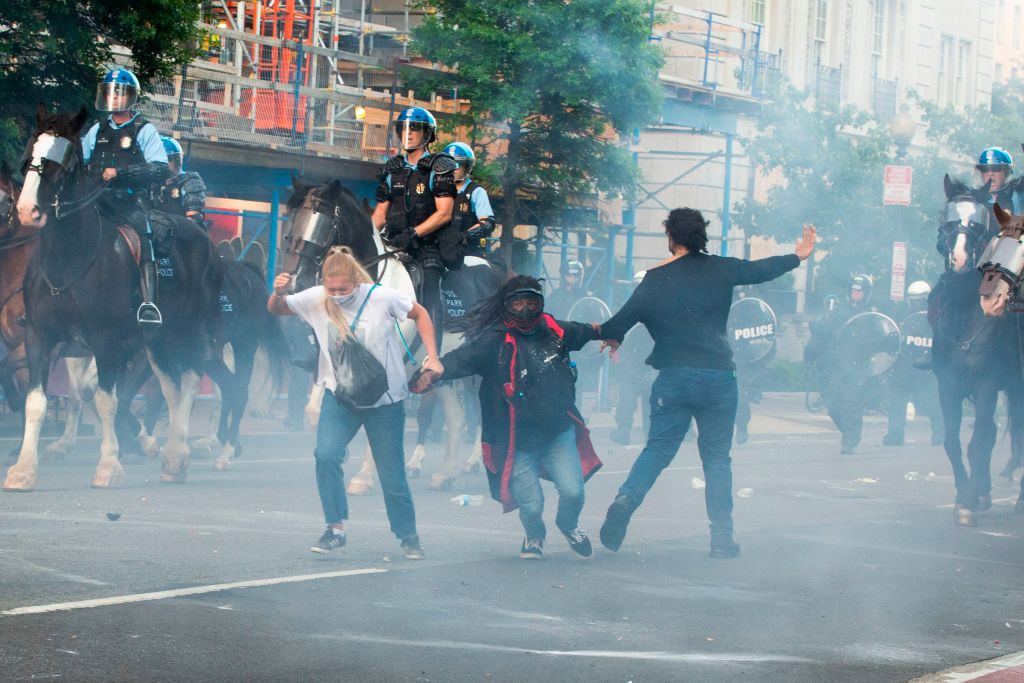
When the now-viral video of police on horseback galloping into protesters at the White House while launching tear gas and pepper bombs released last week, a collective gasp could be heard around the world. U.S. President Donald Trump had presumably decided he was in need of a new character development and a sick plot twist. His latest role? America’s First Autocrat. After a phone call with Vladimir Putin following news of Trump hiding in the White House bunker as protesters marched their way to his doorstep, it’s obvious that Putin’s, ahem, understudy — after some coaching — was ready to take center stage.

What was the purpose of the mayhem caused by police in front of the White House? Simple: It was a photo-op of Trump with a Bible he clearly doesn’t read in front of a church he doesn’t attend. The once seemingly hyperbolic comparisons to Hitler became crystallized. Trump signaled, through a series of disturbing events last week, that he is prepared to do whatever is necessary to hold onto power, even if it means literally and figuratively trampling on the rights of Americans.

Images matter. Just as they did in the 1950s and 1960s when pictures of Emmett Till’s battered body, police dogs, and fire hoses captivated the nation and showcased the brutality of segregation, the same thing is taking place now. During these massive nationwide protests, it is not just Black bodies being brutalized in the streets by police. The message is becoming clear for those who have been able to avoid the long stick of the law because their complexion has been their protection. The police, enabled by a fascist leader, are the problem.

The sight of Trump holding a Bible after he had police forcefully remove protesters is an abomination in so many ways, and the nation’s leaders felt the same. Washington Archbishop Wilton Gregory was among the outraged, saying, “I find it baffling and reprehensible that any Catholic facility would allow itself to be so egregiously misused and manipulated in a fashion that violates our religious principles, which call us to defend the rights of all people, even those with whom we might disagree.” Yet, Trump’s base hailed the stunt as “heroic” and claimed that it signaled that God hates racism and lawlessness.

The reality is that we can no longer turn the channel or a blind eye to what Trump and his White Evangelical base are setting up here, which to be clear, is a complete and total authoritarian takeover of America. Do you remember when Attorney General William Barr declared in a speech to the Federalist Society last November that he believed America was going to hell? And that Trump’s political opponents “engaged in the systematic shredding of norms and the undermining of the rule of law.” Who can forget Barr’s infamous speech at Notre Dame when he said that “secularists” were creating “moral chaos.” So, it makes sense, then, that reports have come out and said it was Barr’s idea to clear the protesters from the White House. It was his desire to flex the muscles and show the “might” of the Trump White House. This was his opportunity to halt the “moral chaos” he has so openly talked about in order to create order.

The chaos that he speaks of, however, is being carried out at the hands of the police, not the “secularists” he rebukes. The problem of police brutality in this country is not a case of a few bad apples but rather that of a poisoned orchard, and the Minneapolis City Council at least has signaled that they now see the larger problem. In a stunning move over the weekend, they voted to disband the police with the president of the council, Lisa Bender, saying, “We are here because here in Minneapolis and in cities across the United States it is clear that our existing system of policing and public safety is not keeping our communities safe. … Our efforts at incremental reform have failed. Period.”

We can’t continue to look at the actions of police nationwide, this president, and his enablers in silos. It is all part of a greater plan to introduce a new world order in America that meshes the lines between church and state and obedience versus subjugation — with the sole purpose of dismantling our democracy.

This is what happens in countries before a collapse.

Former CIA officials also issued a stark warning last week. Gail Helt, a former CIA analyst who has tracked developments throughout Asia said to the Washington Post, “I’ve seen this type of violence. This is what autocrats do. This is what happens in countries before a collapse. It really does unnerve me.” How could you not be unnerved when a leaked call to governors caught Defense Secretary Mark Esper telling them to “dominate the battlespace” and we watch as the joint chief of staff tours the streets of the nation’s capital in fatigues as if he were in a war zone. This is what strength looks like to Trump and his cultish members. It looks like every military movie you have ever watched come to life. It looks like unnamed White men in green shirts guarding the White House. It looks like video after video of police officers beating American citizens to the ground as they exercise their right to assemble and protest.

Imagine that in the midst of a global pandemic, Americans are being forced from the safety of quarantine to the streets so their fellow Black citizens can be treated as equal. We as Black people have always been forced to risk our lives to do what was right and to try with each generation to realize a more perfect union, but now this confluence of pandemics is at times too overwhelming. Black Americans have been saying that we can’t breathe for centuries at this point, and still this country provides no oxygen, no relief. Instead, our calls for liberation and justice are met with tear gas meant to choke us into the silence the same way Derek Chauvin’s knee did George Floyd.

Trump and his enablers don’t want to hear from us. They don’t want to see us. Their continued escalation shows us one thing — they are ready for war. They will do what is necessary to threaten us into submission before they lift a finger or a knee off the backs of Black Americans. Ask yourself why it was so easy to get the military deployed to American cities to stop people from protesting, but this same military wasn’t directed to produce personal protective equipment or build hospitals? Why was Trump so eager to phone governors from the safety of his bunker and tell them how to deal with their residents but hasn’t surveyed hospitals in their states crippled by the coronavirus? Simple: He does not care. Trump wants one thing and that is power, and he will do anything to get it. This president’s “do it for the ’gram” attitude is putting lives at risk.

The question we need to ask ourselves is what we are willing to risk in order to secure our democracy — what are we willing to give up in order to secure a liberated future for every Black child in America? Trump has drawn the battle lines, and courageous Americans are showing us each and every day with protests in all 50 states that they are ready to cross it — by any means necessary.

WITH UNPRECEDENTED FORCE AND SPEED, THE WORLD ECONOMY ABOUT TO GO INTO A TAILSPIN

Here is why.

Because according to the Institute of International Finance global debt, including borrowing by households, governments and companies have jumped to more than three times the size of the global economy.

Because consumption has been subsidized w/debt borrowed.

Because preparedness for a potential Pandemic is low.

Because in an increasingly fractured world where nationalism is often prized over cooperation.

Because multinational institutions have little or no teeth.  

Because there will be a bloodbath on the world stock markets.

Because without trucks, ships, etc goods don’t move.

Because of runaway cost inflation. Less consumption, idle factories, broken global supply chains.

Because of the purchasing power of money. Without the massive government subsidies, there would be no banking profits, no management bonuses, no functioning finance. 

Because you can’t print your way out of debt. 

Because what we have is all government spending is debt because most are borrowed from the magical money machine called the Central Bank

Because No one knows what to do. We are in new territory here. By the time we figure out how to do it climate change will produce billions of refugees

Because clickbait headlines flooded the Internet.

Because anyone who doesn’t think the outbreak of the virus will not have a huge impact on their way of life, our economy and the world economy is truly ignorant of the situation. The opiate of the uncultivated herd.

Because right now it is interfering with the production of all sorts of things that most of us take for granted every single day.

Because China is losing billions a day.

Because it’s not possible to quarantine the world and the virus will probably with us beyond this year. a new mutation of the coronavirus will hit us every year, and it will keep coming back.

Because let’s call a spade a spade it’s going to get very ugly over the next few months. Do you know where your money really is?

My personal opinion is to keep your natural immune system at the highest working levels. I cannot prescribe anything. Ignore the click-bait headlines meant to get you on some web site. 

The moment of truth is yet to come we will be all offline however perception drives reality.

If the people on this planet believe that their health is threatened by this virus, the global economy, already on thin ice, will collapse. 

It is going to cost the global economy more than money unfortunately some of us will never know what hit it.  Covid-19 another word for Inequality.

Assuming markets don’t go into a tailspin, the economic impact of the virus this year will vary from nation to nation, depending on how much stimulus the government can afford. Investors are confident that Beijing will spend whatever it takes to keep China’s economy moving, and that the Fed will provide enough easy money to keep growth alive in the United States. High in the at-risk category: Italy and Japan, both hard hit by the coronavirus, and hard pressed to fund new stimulus measures.

Whatever course the coronavirus takes, it is already accelerating de-globalisation, which began when countries turned inward after the global financial crisis of 2008 and cross-border flows of people, goods and money slowed. Fear of contagion is likely to deepen the conviction of populist politicians who want to block imports and immigrants anyway.

The trend towards localisation – companies looking to produce more locally, and consumers looking to buy from local brands – is likely to pick up speed. The roster of manufacturers who are moving factories out of China, in search of lower wages and a less risky business environment, will grow.

The longer the virus lasts and the farther it spreads, the bigger these impacts will be. Hopefully, history repeats itself and like other epidemics this one too peaks and passes quickly. But one thing the coronavirus has already shown is that the market is a fickle beast and its daily medical opinions need to be read with caution.

While Corporate America gets a bailout, Main Street loses everything, however, the people are getting wise

Over the past decade, anyone studying the stock market will have realized modern-day economic growth is artificial: years of money printing, stimulus packages, and tax breaks funded by an ever-increasing deficit. It’s a Ponzi, but on a massive scale. A fraudulent investing scam promising high rates of return with little risk to investors — an accurate depiction of recent market events.

Here’s how it works: the Federal Reserve creates “new money” from thin air via money printing — typing numbers into the Fed’s computer. Then, the central bank loans this new money to the megabanks, who then issue loans to businesses and consumers. Loans, of course, are vital for growth, but they have become the bread and butter of our economy and society has become over-reliant on debt. New loans are painting over bad existing loans. It’s a system that’s unstoppable unless a major black swan — or white swan — disrupts the cheap money flow.

COVID-19 was that disruption: First, crashing the economy; second, exposing the stock market as a fraud: A decade of bogus earnings growth fueled by stock buybacks, fueled by risky debt. Buying back stock used to be illegal and for good reason: it’s a form of insider trading. CEOs realized this, but to keep the market happy, they bought every share they got their hands on, pumping up stock prices to bolster their equity and bonuses, instead of investing in infrastructure, cash flow, and their employees. The Coronavirus put an end to this, destroying profits, hence, destroying their ability to buy back stock.

Now, with their inability to produce earnings growth — real or fake — the offending companies are facing the consequences. Let’s say you’re a public airline company that will fail without a bailout. Instead of saving for a rainy day, you are both cashless and profitless. After a decade, what do you have to show for it?: A stock bubble that’s going to burst when the economy collapses.

But just like in 2008 with the megabanks, it’s the corporations engaging in risky activity that will receive bailout money. Because of the Fed’s decision to buy risky corporate debt, the Ponzi is kept alive, CEOs keep their equity, and debt investors keep their bonds.

Outside the corporate bubble, however, real America suffers. Let’s say you’re a small business. You’ve been saving for a rainy day while making prudent investment decisions over the last business cycle. But because of the virus, you take a colossal hit. While your door remains closed as the world remains on lockdown, you fire staff or furlough them, you dig into your emergency fund to survive. But no bailouts for you. You and your employees have lost their job, their careers, and their financial security. Everyone is wiped out.

This is capitalism for the people and socialism for the rich.

As a result, people are finally becoming wise to the corporate Ponzi scheme. Individuals who reject the phony economic system are looking for guidance. There’s a big misconception, however, that everyone in the finance industry is there to take your money, only caring about the value of their assets while leaving hard-working people holding the bag. This is false.

Over the past decade, the top talent has left Wall Street, starting their own funds, and warning people about Wall Street’s “buy stocks” machine: replacing human traders with algorithms that make up 80% of the daily volume and with salesmen who perpetrate the “stocks only go up” narrative. A narrative that’s created double-digit percentage losses for retail investors.

The word is out on FinTwit: Twitter’s hidden but open financial community where non-institutional investors receive insights from finance pros who have escaped the Wall Street bubble. These money managers don’t want to participate in and perpetuate the narrative because they know what happens next. While Wall Street was urging retail investors to buy stocks at the peaks in 2001, 2008, and 2020, FinTwit got Main Street out.

Inside the Wall Street bubble, investors have yet to escape the “stocks go up forever” fallacy, due to loose monetary policy and interest rate suppression, think they have no choice but to take part. Let’s face it, it’s hard to escape. Our options are limited, so the simplicity of just hoping stocks will go up is attractive. We can’t leave our life savings in the bank because, with a realistic inflation rate of 5%, we lose 5% of their purchasing power each year. We can’t put their money in bonds because yields are so low. It’s also hard to outsource wealth management to successful money managers because our savings balance is below the minimum they require.

Instead, they are clinging onto their stocks, not because of fundamentals, but because of the “buy the dip” mentality that’s worked for so long. Some are even committing more capital. But what happens when we get to new all-time highs with a depression looming and with an economy already slowing pre-virus? Wall Street’s goal is to bail out its buddies and leave Main Street holding the bag.

Slowly but surely, most people will free themselves as reality kicks in. They will pull their money from the system, moving their wealth into anti-system, anti-repressive assets like gold, silver, and cryptocurrencies — even into other tangible assets like fine wine and fine art.

If you’re tired of the same-old-same-old and sick of financial repression, you can do the same. Now’s the time to pull the plug. Recent moves by the Fed means a monetary revolution will come sooner rather than later. The people are angry and they want system change now.

Society will tear itself apart! The root causes will remain the same. We have no clue about what we are doing, but we are the best at telling others what to do!

There is a putrid stench fermenting just beneath the surface of 21st-century society.

Will this change in the next 150 years?  Probably not.

To be able to understand the future, you must know the past.

So what has taken us to where we are today and what has changed along the way?The world has changed a lot in the last 150 years, but we humans are driven by the same basic needs as we were 150 years ago, food, sleep, sex, the feeling of being appreciated and loved.

However, it seems these days that there is this omnipresent feeling that the world is going fucking crazy.

You would think by now we would all realize that we have to live together. That we are all racist following policies that encourage racism, inequality, that waste of half of the food produced worldwide resulting in wars.

But the world isn’t as bad as it was a century ago.

It’s just that we’re more aware of all of the bad things than ever before.

The violence is not new; it’s the cameras that are new.

Cameras, the internet, and most importantly, social media.

This is what’s new.

This is what’s different.

How we’re getting information, what information is reaching us, and most importantly, what information and views we are most rewarded for sharing.

We feel desensitized and dejected from the seemingly constant carnage raging across the planet.

The internet has generated a platform where apocalyptic beliefs are celebrated and spread, and moderation and reason is something that becomes too arduous and boring to stand.

It is what is causing this constant feeling of a chaotic and insecure world that doesn’t actually exist. And then: it’s this feeling that is the cause of the renewed xenophobia and nationalism across the western world.

It’s this feeling that has consumed the consciousness of millions of people and caused them to look at their country through the lens of a surreal world exaggerating all that is wrong and minimizing all that is right.

Despite living with more safety and wealth and access to information than anyone in human history, we feel as though the world is going crazy and something drastic must be changed.

By now, we’re all familiar with the tech world circle-jerk about how we’re connecting the planet and the world is getting smaller and we’re all becoming one big Kum Ba Ya global community and how this is amazing because starving people in Yahem to a mass shooting in El Paso can each have their own iPad, and blah, blah, blah, the internet is cool.

Outrageous news and information spread faster and further than any other form of information, dominating our daily attention.

On the other hand, the rise of the internet and social media has accelerated social progress in many ways. It’s helped herald a breakthrough in LGBT rights, it’s raised awareness about discrimination against women and minorities, and fomented the populist overthrow of a number of repressive governments worldwide.

Activists and concerned citizens can quickly mobilize to spread the word and hold the appropriate authorities accountable for change.

This is our brave new world.

When all information is freely available at the click of a mouse, our attention naturally nosedives into the sickest and most grotesque we can find, ignoring the reality of climate change.

To protect ourselves from the overreaching judgments of others, we consolidate into our own clans and tribes, we take refuge in our own precious identity politics and we buy more and more into a worldview that is disconnected from cold data and hard facts.

We become only exposed to the most extreme negative aspects of certain groups of people, giving us a skewed view of how other people in the world really think, act, and live. We demonize each other.

We judge groups of people by their weakest and most depraved members.

Take Brexit, for example, presently being sold as taking back sovereignty to gain freedom from the EU.

Freedom can only exist when you are willing to tolerate views that oppose your own when you’re willing to give up some of your desires for the sake of a safe and healthy community when you’re willing to compromise and accept that sometimes things don’t go your way and that’s fine.

The only way to beat the attention economy is to opt-out of it.

Instead,

I am attempting to go back to learning about the world only through long-form journalism that has been thoroughly researched and vetted before being published.

I’m exercising the muscles in my brain responsible for focus, depth, and concentration. I’m stretching out my logic, trying to challenge my own beliefs and always holding on to a healthy amount of doubt.

In a weird sense, true freedom doesn’t exist.

Because the only way for human rights to persist is for everyone to collectively agree to accept that things don’t have to go their way 100% of the time.

They want a freedom to express themselves but they don’t want to have to deal with views that may upset or offend them in some way. They want a freedom to enterprise but they don’t want to pay taxes to support the legal machinery that makes it possible. They want a freedom to elect representatives to the government but they don’t want to compromise when they’re on the losing side.

A free and functioning democracy demands a populace that is able to sustain discomfort, that is able to tolerate dissatisfaction, that is able to be charitable and forgiving of groups whose views stand in contrast to one’s own, and most importantly, that is able to remain unswayed in the face of some violent threat.

We’re seeing a lazy entitlement wash over the world where everyone feels as though they deserve what they want from their government the second they want it, without thought of repercussions or the rest of the population.

It seems like people don’t actually want democracy anymore, they want a dictator who agrees with them.

The choice is, do you and I consume what is here now and change the planet to something unknown and different for the next generations?

Or do you and I slow our consumption to a regenerative rate, ensuring the same planet we live on now is here for the generations to come?

This is a personal choice.

It isn’t something an outside party, such as the government is going to fix.

You and I are the consumers. You and I are the ones making the choices.

What choice will you and I make in the future? They will be governed by Climate change.

You will not find these choices in the cloud.

I believe in the next ten years, science will prove that too much technology (e.g. heads always in our phones) is actually a negative thing for the mind and longevity.

I believe we’ll be forced by climate change to find a sustainable balance between technology use and real-life experiences.

All too often, problems being solved in tech are first world problems.

Many of us forget that there are some huge global problems, particularly in the developing world, that need to be solved for the benefit of us all.

But we have to take charge soon and make it so.

UNFORTUNATELY, OUR HISTORICAL FOOTPRINT TELL US THAT THIS IS A TOTAL IMPOSSIBILITY.

American Pravda: Our Coronavirus Catastrophe as Biowarfare Blowback?

Over 50,000 Americans have died from the coronavirus during the last two weeks, and by some estimates this is a substantial under-count, while the death-toll continues to rapidly mount. Meanwhile, measures to control the spread of this deadly infection have already cost 22 million Americans their jobs, an unprecedented economic collapse that has pushed our unemployment rates to Great Depression levels. Our country is facing a crisis as grave as almost any in our national history.

For many weeks President Trump and his political allies had regularly dismissed or minimized this terrible health threat, and suddenly now faced with such a manifest disaster, they have naturally begun seeking other culprits to blame.

The obvious choice is China, where the global epidemic first began in late 2019. Over the last week or two our media has been increasingly filled with accusations that the dishonesty and incompetence of the Chinese government played a major role in producing our own health catastrophe.

Even more serious charges are also being raised, with senior government officials informing the media that they suspect that the Covid-19 virus was developed in a Chinese laboratory in Wuhan and then carelessly released upon a vulnerable world. Such “conspiracy theories” were once confined to the extreme political fringe of the Internet, but they are now found in the respectable pages of my morning New York Times and Wall Street Journal.

Whether plausible or not, such accusations carry the gravest international implications, and there are growing demands that China financially compensate our country for its trillions of dollars in economic losses. A new global Cold War along both political and economic lines may soon be at hand.

I have no personal expertise in biowarfare technology, nor access to the secret American intelligence reports that seem to have been taken seriously by our most elite national newspapers. But I do think that a careful exploration of previous Sino-American clashes over the last couple of decades may provide some useful insight into the relative credibility of those two governments as well as that of our own media.

During the late 1990s, America seemed to reach the peak of its global power and prosperity, basking in the aftermath of its historic victory in the long Cold War, while ordinary Americans greatly benefited from the record-long economic expansion of that decade. A huge Tech Boom was at its height, and Islamic terrorism seemed a vague and distant thing, almost entirely confined to Hollywood movies. With the collapse of the Soviet Union, the possibility of large scale war seemed to have dissipated so political leaders boasted of the “peace dividend” that citizens were starting to enjoy as our huge military forces, built up over nearly a half-century, were downsized amid sweeping cuts in the bloated defense budget. America was finally returning to a regular peacetime economy, with the benefits apparent to everyone.

At the time, I was overwhelmingly focused on domestic political issues, so I only paid slight attention to our one small military operation of that period, the 1999 NATO air war against Serbia, intended to safeguard the Kosovo Albanians from ethnic cleansing and massacre, a Clinton Administration project that I fully endorsed.

Although our limited bombing campaign seemed quite successful and soon forced the Serbs to the bargaining table, the short war did include one very embarrassing mishap. The use of old maps had led to a targeting error that caused one of our smart bombs to accidentally strike the Chinese Embassy in Belgrade, killing three members of its delegation and wounding dozens more. The Chinese were outraged by this incident, and their propaganda organs began claiming that the attack had been deliberate, a reckless accusation that obviously made no logical sense.

In those days I watched the PBS Newshour every night, and was I shocked to see their U.S. Ambassador raise those absurd charges with host Jim Lehrer, whose disbelief matched my own. But when I considered that the Chinese government was still stubbornly denying the reality of its massacre of the protesting students in Tiananmen Square a decade earlier, I concluded that unreasonable behavior by PRC officials was only to be expected. Indeed, there was even some speculation that China was cynically milking the unfortunate accident for domestic reasons, hoping to stoke the sort of jingoist anti-Americanism among the Chinese people that would finally help bind the social wounds of that 1989 outrage.

Such at least were my thoughts on that matter more than two decades ago. But in the years that followed, my understanding of the world and of many pivotal events of modern history underwent the sweeping transformations that I have described in my American Pravda series. And some of my 1990s assumptions were among them.

Consider, for example, the Tiananmen Square Massacre, which every June 4th still evokes an annual wave of harsh condemnations in the news and opinion pages of our leading national newspapers. I had never originally doubted those facts, but a year or two ago I happened to come across a short article by journalist Jay Matthews entitled “The Myth of Tiananmen” that completely upended that apparent reality.

According to Matthews the infamous massacre had likely never happened, but was merely a media artifact produced by confused Western reporters and dishonest propaganda, a mistaken belief that had quickly become embedded in our standard media storyline, endlessly repeated by so many ignorant journalists that they all eventually believed it to be true. Instead, as near as could be determined, the protesting students had all left Tiananmen Square peacefully, just as the Chinese government had always maintained. Indeed, leading newspapers such as the New York Times and the Washington Post had occasionally acknowledged these facts over the years, but usually buried those scanty admissions so deep in their stories that few ever noticed. Meanwhile, the bulk of the mainstream media had fallen for an apparent hoax.

Matthews himself had been the Beijing Bureau Chief of the Washington Post, personally covering the protests at the time, and his article appeared in the Columbia Journalism Review, our most prestigious venue for media criticism. This authoritative analysis containing such explosive conclusions was first published in 1998, and I find it difficult to believe that many reporters or editors covering China have remained ignorant of this information, yet the impact has been absolutely nil. For over twenty years virtually every mainstream media account I have read has continued to promote the Tiananmen Square Massacre Hoax, usually implicitly but sometimes explicitly.

Even more remarkable were the discoveries I made regarding our supposedly accidental bombing of the Chinese Embassy in 1999. Not long after launching this website, I added former Asia Times contributor Peter Lee as a columnist, incorporating his China Matters blogsite archives that stretched back for a decade. He soon published a 7,000 word article on the Belgrade Embassy bombing, representing a compilation of material already contained in a half-dozen previous pieces he’d written on that subject from 2007 onward. To my considerable surprise, he provided a great deal of persuasive evidence that the American attack on the Chinese embassy had indeed been deliberate, just as China had always claimed.

According to Lee, Beijing had allowed its embassy to be used as a site for secure radio transmission facilities by the Serbian military, whose own communications network was a primary target of NATO airstrikes. Meanwhile, Serbian air defenses had shot down an advanced American F-117A fighter, whose top-secret stealth technology was a crucial U.S. military secret. Portions of that enormously valuable wreckage were carefully gathered by the grateful Serbs, who delivered it to the Chinese for temporary storage at their embassy prior to transport back home. This vital technological acquisition later allowed China to deploy its own J20 stealth fighter in early 2011, many years sooner than American military analysts had believed possible.

Based upon this analysis, Lee argued that the Chinese embassy was attacked in order to destroy the Serbian retransmission facilities located there, while punishing the Chinese for allowing such use. There were also widespread rumors in China that another motive had been an unsuccessful attempt to destroy the stealth debris stored within. Later Congressional testimony revealed that the among all the hundreds of NATO airstrikes, the attack on the Chinese embassy was the only one directly ordered by the CIA, a highly-suspicious detail.

I was only slightly familiar with Lee’s work, and under normal circumstances I would have been very cautious in accepting his remarkable claims against the contrary position universally held by all our own elite media outlets. But the sources he cited completely shifted that balance.

Although the American media dominates the English-language world, many British publications also possess a strong global reputation, and since they are often much less in thrall to our own national security state, they have sometimes covered important stories that were ignored here. And in this case, the Sunday Observer published a remarkable expose in October 1999, citing several NATO military and intelligence sources who fully confirmed the deliberate nature of the American bombing of the Chinese embassy, with a US colonel even reportedly boasting that their smartbomb had hit the exact room intended.

This important story was immediately summarized in the Guardian, a sister publication, and also covered by the rival Times of London and many of the world’s other most prestigious publications, but encountered an absolute wall of silence in our own country. Such a bizarre divergence on a story of global strategic importance—a deliberate and deadly US attack against Chinese diplomatic territory—drew the attention of FAIR, a leading American media watchdog group, which published an initial critique and a subsequent follow-up. These two pieces totaled some 3,000 words, and effectively summarized both the overwhelming evidence of the facts and also the heavy international coverage, while reporting the weak excuses made by top American editors to explain their continuing silence. Based upon these articles, I consider the matter settled.

Few Americans remember our 1999 attack upon the Chinese embassy in Belgrade, and if not for the annual waving of a bloody June 4th flag by our ignorant and disingenuous media, the “Tiananmen Square Massacre” would also have long since faded from memory. Neither of these events has much direct importance today, at least for our own citizens. But the broader media implications of these examples do seem quite significant.

These incidents represented two of the most serious flashpoints between the Chinese and American governments during the last thirty-odd years. In both cases the claims of the Chinese government were entirely correct, although they were denied by our own top political leaders and dismissed or ridiculed by virtually our entire mainstream media. Moreover, within a few months or a year the true facts became known to many journalists, even being reported in fully respectable venues. But that reality was still completely ignored and suppressed for decades, so that today almost no American whose information comes from our regular media would even be aware of it. Indeed, since many younger journalists draw their knowledge of the world from these same elite media sources, I suspect that many of them have never learned what their predecessors knew but dared not mention.

Most leading Chinese media outlets are owned or controlled by the Chinese government, and they tend to broadly follow the government line. Leading American media outlets have a corporate ownership structure and often boast of their fierce independence; but on many crucial matters, I think the actual reality is not so very different from that in China.

I tend to doubt that Chinese leaders have any overwhelming commitment to the truth, and the reasons for their greater veracity are probably practical ones. American news and entertainment completely dominate the global media landscape and they face no significant domestic rival. So China recognizes that it is vastly outmatched in any propaganda conflict, and as the far weaker party must necessarily try to stick closer to the truth, lest its lies be immediately exposed. Meanwhile, America’s overwhelming control over global information may inspire considerable hubris, with the government sometimes promoting the most outrageous and ridiculous falsehoods in the confident belief that a supportive American media will cover for any mistakes.

These considerations should be kept in mind as we attempt to sift the accounts of our often unreliable and dishonest media in hopes of extracting the true circumstances of the current coronavirus epidemic. Unlike careful historical studies, we are working in real-time and our analysis is greatly hindered by the ongoing fog of war, so that any conclusions are necessarily very preliminary ones. But given the high stakes, such an attempt seems warranted.

When my morning newspapers first began mentioning the appearance of a mysterious new illness in China during mid-January, I paid little attention, absorbed as I was in the aftermath of our sudden assassination of Iran’s top military leader and the dangerous possibility of a yet another Middle Eastern war. But the reports persisted and grew, with deaths occurring and evidence growing that the viral disease could be transmitted between humans. China’s early conventional efforts seemed unsuccessful in halting the spread of the disease.

Then on Jan. 23rd and after only 17 deaths, the Chinese government took the astonishing step of locking down and quarantining the entire 11 million inhabitants of the city of Wuhan, a story that drew worldwide attention. They soon extended this policy to the 60 million Chinese of Hubei province, and not longer afterward shut down their entire national economy and confined 700 million Chinese to their homes, a public health measure probably a thousand times larger than anything previously undertaken in human history. So either the China’s leadership had suddenly gone insane, or they regarded this new virus as an absolutely deadly national threat, one that needed to be controlled at any possible cost.

Given these dramatic Chinese actions and the international headlines that they generated, the current accusations by Trump Administration officials that China had attempted to minimize or conceal the serious nature of the disease outbreak is so ludicrous as to defy rationality. In any event, the record shows that on December 31st, the Chinese had already alerted the World Health Organization to the strange new illness, and Chinese scientists published the entire genome of the virus on Jan. 12th, allowing diagnostic tests to be produced worldwide.

Unlike other nations, China had received no advance warning of the nature or existence of the deadly new disease, and therefore faced unique obstacles. But their government implemented public health control measures unprecedented in the history of the world and managed to almost completely eradicate the disease with merely the loss of a few thousand lives. Meanwhile, many other Western countries such as the US, Italy, Spain, France, and Britain dawdled for months and ignored the potential threat, and have now suffered well over 100,000 dead as a consequence, with the toll still rapidly mounting. For any of these nations or their media organs to criticize China for its ineffectiveness or slow response represents an absolute inversion of reality.

Some governments took full advantage of the early warning and scientific information provided by China. Although nearby East Asian nations such as South Korea, Japan, Taiwan, and Singapore had been at greatest risk and were among the first infected, their competent and energetic responses allowed them to almost completely suppress any major outbreak, and they have suffered minimal fatalities. But America and several European countries avoiding adopting these same early measures such as widespread testing, quarantine, and contact-tracing, and have paid a terrible price for their insouciance.

A few weeks ago British Prime Minister Boris Johnson boldly declared that his own disease strategy for Britain was based upon rapidly achieving “herd immunity”—essentially encouraging the bulk of his citizens to become infected—then quickly backed away after his desperate advisors recognized that the result might entail a million or more British deaths.

By any reasonable measure, the response to this global health crisis by China and most East Asian countries has been absolutely exemplary, while that of many Western countries has been equally disastrous. Maintaining reasonable public health has been a basic function of governments since the days of the city-states of Sumeria, and the sheer and total incompetence of America and most of its European vassals has been breathtaking. If the Western media attempts to pretend otherwise, it will permanently forfeit whatever remaining international credibility it still possesses.

I do not think these particular facts are much disputed except among the most blinkered partisans, and the Trump Administration probably recognizes the hopelessness of arguing otherwise. This probably explains its recent shift towards a far more explosive and controversial narrative, namely claiming that Covid-19 may have been the product of Chinese research into deadly viruses at a Wuhan laboratory, which suggests that the blood of hundreds of thousands or millions of victims around the world will be on Chinese hands. Dramatic accusations backed by overwhelming international media power may deeply resonate across the globe.

News reports appearing in the Wall Street Journal and the New York Times have been reasonably consistent. Senior Trump Administration officials have pointed to the Wuhan Institute of Virology, a leading Chinese biolab, as the possible source of the infection, with the deadly virus having been accidentally released, subsequently spreading first throughout China and later worldwide. Trump himself has publicly voiced similar suspicions, as did Secretary of State and former CIA Director Mike Pompeo in a FoxNews interview. Private lawsuits against China in the multi-trillion-dollar range have already been filed by rightwing activists and Republican senators Tom Cotton and Lindsey Graham have raised similar governmental demands.

I obviously have no personal access to the classified intelligence reports that have been the basis of these charges by Trump, Pompeo, and other top administration officials. But in reading these recent news accounts, I noticed something rather odd.

Back in January, few Americans were paying much attention to the early reports of an unusual disease outbreak in the Chinese city of Wuhan, which was hardly a household name. Instead, overwhelming political attention was focused on the battle over Trump’s impeachment and the aftermath of our dangerous military confrontation with Iran. But towards the end of that month, I discovered that the fringes of the Internet were awash with claims that the disease was caused by a Chinese bioweapon accidentally released from that same Wuhan laboratory, with former Trump advisor Steve Bannon and ZeroHedge, a popular right-wing conspiracy-website, playing leading roles in advancing the theory. Indeed, the stories became so widespread in those ideological circles that Sen. Tom Cotton, a leading Republican Neocon, began promoting them on Twitter and FoxNews, thereby provoking an article in the NYT on those “fringe conspiracy theories.”

I suspect that it may be more than purely coincidental that the biowarfare theories which erupted in such concerted fashion on small political websites and Social Media accounts back in January so closely match those now publicly advocated by top Trump Administration officials and supposedly based upon our most secure intelligence sources. Perhaps a few intrepid citizen-activists managed to replicate the findings of our multi-billion-dollar intelligence apparatus, and did so in days while the latter required weeks or months. But a more likely scenario is that the wave of January speculation was driven by private leaks and “guidance” provided by exactly the same elements that today are very publicly leveling similar charges in the elite media. Initially promoting controversial theories in less mainstream outlets has long been a fairly standard intelligence practice.

Regardless of the origins of the idea, does it seem plausible that the coronavirus outbreak might have originated as an accidental leak from that Chinese laboratory? I am not privy to the security procedures of Chinese government facilities, but applying a little common sense may shed some light on that question.

Although the coronavirus is only moderately lethal, apparently having a fatality rate of 1% or less, it is extremely contagious, including during an extended pre-symptomatic period and also among asymptomatic carriers. Thus, portions of the US and Europe are now suffering heavy casualties, while the policies adopted to control the spread have devastated their national economies. Although the virus is unlikely to kill more than a small sliver of our population, we have seen to our dismay how a major outbreak can so easily wreck our entire economic life.

During January, the journalists reporting on China’s mushrooming health crisis regularly emphasized that the mysterious new viral outbreak had occurred at the worst possible place and time, appearing in the major transport hub of Wuhan just prior to the Lunar New Year holiday, when hundreds of millions of Chinese would normally travel to their distant family homes for the celebration, thereby potentially spreading the disease to all parts of the country and producing a permanent, uncontrollable epidemic. The Chinese government avoided that grim fate by the unprecedented decision to shut down its entire national economy and confine 700 million Chinese to their own homes for many weeks. But the outcome seems to have been a very near thing, and if Wuhan had remained open for just a few days longer, China might easily have suffered long-term economic and social devastation.

The timing of an accidental laboratory release would obviously be entirely random. Yet the outbreak seems to have begun during the precise period of time most likely to damage China, the worst possible ten-day or perhaps thirty-day window. As I noted in January, I saw no solid evidence that the coronavirus was a bioweapon, but if it were, the timing of the release seemed very unlikely to have been accidental.

If the virus was released intentionally, the context and motive for such a biowarfare attack against China could not be more obvious. Although our disingenuous media continues to pretend otherwise, the size of China’s economy surpassed that of our own several years ago, and has continued to grow much more rapidly. Chinese companies have also taken the lead in several crucial technologies, with Huawei becoming the world’s leading telecommunications equipment manufacturer and dominating the important 5G market. China’s sweeping Belt and Road Initiative has threatened to reorient global trade around an interconnected Eurasian landmass, greatly diminishing the leverage of America’s own control over the seas. I have closely followed China for over forty years, and the trend-lines have never been more apparent. Back in 2012, I published an article bearing the provocative title “China’s Rise, America’s Fall?” and since then I have seen no reason to reassess my verdict.

For three generations following the end of World War II, America had stood as the world’s supreme economic and technological power, while the collapse of the Soviet Union thirty years ago left us as the sole remaining superpower, facing no conceivable military rival. A growing sense that we were rapidly losing that unchallenged position had certainly inspired the anti-China rhetoric of many senior figures in the Trump Administration, who launched a major trade war soon after coming into office. The increasing misery and growing impoverishment of large sections of the American population naturally left these voters searching for a convenient scapegoat, and the prosperous, rising Chinese made a perfect target.

Despite America’s growing economic conflict with China over the last couple of years, I had never considered the possibility that matters might take a military turn. The Chinese had long ago deployed advanced intermediate range missiles that many believed could easily sink our carriers in the region, and they had also generally improved their conventional military deterrent. Moreover, China was on quite good terms with Russia, which itself had been the target of intense American hostility for several years; and Russia’s new suite of revolutionary hypersonic missiles had drastically reduced any American strategic advantage. Thus, a conventional war against China seemed an absolutely hopeless undertaking, while China’s outstanding businessmen and engineers were steadily gaining ground against America’s decaying and heavily-financialized economic system.

Under these difficult circumstances, an American biowarfare attack against China might have seemed the only remaining card to play in hopes of maintaining American supremacy. Plausible deniability would minimize the risk of any direct Chinese retaliation, and if successful, the terrible blow inflicted to China’s economy would set it back for many years, perhaps even destabilizing its social and political system. Using alternative media to immediately promote theories that the coronavirus outbreak was the result of a leak from a Chinese biowarfare lab was a natural means of preempting any later Chinese accusations along similar lines, thereby allowing America to win the international propaganda war before China had even begun to play.

A decision by elements of our national security establishment to wage biological warfare in hopes of maintaining American world power would certainly have been an extremely reckless act, but extreme recklessness has become a regular aspect of American behavior since 2001, especially under the Trump Administration. Just a year earlier we had kidnapped the daughter of Huawei’s founder and chairman, who also served as CFO and ranked as one of China’s most top executives, while at the beginning of January we suddenly assassinated Iran’s top military leader.

These were the thoughts that entered my mind during the last week of January once I discovered the widely circulating theories suggesting that China’s massive disease epidemic had been the self-inflicted consequence of its own biowarfare research. I saw no solid evidence that the coronavirus was a bioweapon, but if it were, China was surely the innocent victim of the attack, presumably carried out by elements of the American national security establishment.

Soon afterward, someone brought to my attention a very long article by an American ex-pat living in China who called himself “Metallicman” and held a wide range of eccentric and implausible beliefs. I have long recognized that flawed individuals can often serve as the vessels of important information otherwise unavailable, and this case constituted a perfect example. His piece denounced the outbreak as a likely American biowarfare attack, and provided a great wealth of factual material I had not previously considered. Since he authorized republication elsewhere I did so, and his 15,000 word analysis, although somewhat raw and unpolished, began attracting an enormous amount of readership on our website, probably being one of the very first English-language pieces to suggest that the mysterious new disease was an American bioweapon. Many of his arguments appeared doubtful to me or have been obviated by later developments, but several seemed quite telling.

He pointed out that during the previous two years, the Chinese economy had already suffered serious blows from other mysterious new diseases, although these had targeted farm animals rather than people. During 2018 a new Avian Flu virus had swept the country, eliminating large portions of China’s poultry industry, and during 2019 the Swine Flu viral epidemic had devastated China’s pig farms, destroying 40% of the nation’s primary domestic source of meat, with widespread claims that the latter disease was being spread by mysterious small drones. My morning newspapers had hardly ignored these important business stories, noting that the sudden collapse of much of China’s domestic food production might prove a huge boon to American farm exports at the height of our trade conflict, but I had never considered the obvious implications. So for three years in a row, China had been severely impacted by strange new viral diseases, though only the most recent had been deadly to humans. This evidence was merely circumstantial, but the pattern seemed highly suspicious.

The writer also noted that shortly before the coronavirus outbreak in Wuhan, that city had hosted 300 visiting American military officers, who came to participate in the 2019 Military World Games, an absolutely remarkable coincidence of timing. As I pointed out at the time, how would Americans react if 300 Chinese military officers had paid an extended visit to Chicago, and soon afterward a mysterious and deadly epidemic had suddenly broken out in that city? Once again, the evidence was merely circumstantial but certainly raised dark suspicions.

Scientific investigation of the coronavirus had already pointed to its origins in a bat virus, leading to widespread media speculation that bats sold as food in the Wuhan open markets had been the original disease vector. Meanwhile, the orchestrated waves of anti-China accusations had emphasized Chinese laboratory research on that same viral source. But we soon published a lengthy article by investigative journalist Whitney Webb providing copious evidence of America’s own enormous biowarfare research efforts, which had similarly focused for years on bat viruses. Webb was then associated with MintPress News, but that publication had strangely declined to publish her important piece, perhaps skittish about the grave suspicions it directed towards the US government on so momentous an issue. So without the benefit of our platform, her major contribution to the public debate might have attracted relatively little readership.

Around the same time, I noted another extremely strange coincidence that failed to attract any interest from our somnolent national media. Although his name had meant nothing to me, in late January my morning newspapers carried major stories on the sudden arrest of Prof. Charles Lieber, one of Harvard University’s top scientists and Chairman of its Chemistry Department, sometimes characterized as a potential future Nobel Laureate.

The circumstances of that case seemed utterly bizarre to me. Like numerous other prominent American academics, Lieber had had decades of close research ties with China, holding joint appointments and receiving substantial funding for his work. But now he was accused of financial reporting violations in the disclosure portions of his government grant applications—the most obscure sort of offense—and on the basis of those accusations, he was seized by the FBI in an early-morning raid on his suburban Lexington home and dragged off in shackles, potentially facing years of federal imprisonment.

Such government action against an academic seemed almost without precedent. During the height of the Cold War, numerous American scientists and technicians were rightfully accused of having stolen our nuclear weapons secrets for delivery to Stalin, yet I had never heard of any of them treated in so harsh a manner, let alone a scholar of Prof. Lieber’s stature, who was merely charged with technical disclosure violations. Indeed, this incident recalled accounts of NKVD raids during the Soviet purges of the 1930s.

Although Lieber was described as a chemistry professor, a few seconds of Googling revealed that some of his most important work had been in virology, including technology for the detection of viruses. So a massive and deadly new viral epidemic had broken out in China and almost simultaneously, a top American scholar with close Chinese ties and expertise in viruses was suddenly arrested by the federal government, yet no one in the media expressed any curiosity at a possible connection between these two events.

I think we can safely assume that Lieber’s arrest by the FBI had been prompted by the concurrent coronavirus epidemic, but anything more is mere speculation. Those now accusing China of having created the coronavirus might surely suggest that our intelligence agencies discovered that the Harvard professor had been personally involved with that deadly research. But I think a far more likely possibility is that Lieber began to wonder whether the epidemic in China might not be the result of an American biowarfare attack, and was perhaps a little too free in voicing his suspicions, thereby drawing the wrath of our national security establishment. Inflicting such extremely harsh treatment upon a top Harvard scientist would greatly intimidate all of his lesser colleagues elsewhere, who would surely now think twice before broaching certain controversial theories to any journalist.

By the end of January, our webzine had published a dozen articles and posts on the coronavirus outbreak, then added many more by the middle of February. These pieces totaled tens of thousands of words and attracted a half million words of comments, probably representing the primary English-language source for a particular perspective on the deadly epidemic, with this material eventually drawing many hundreds of thousands of pageviews. A few weeks later, the Chinese government began gingerly raising the possibility that the coronavirus may have been brought to Wuhan by the 300 American military officers visiting that city, and was fiercely attacked by the Trump Administration for spreading anti-American propaganda. But I strongly suspect that the Chinese had gotten that idea from our own publication.

As the coronavirus gradually began to spread beyond China’s own borders, another development occurred that greatly multiplied my suspicions. Most of these early cases had occurred exactly where one might expect, among the East Asian countries bordering China. But by late February Iran had become the second epicenter of the global outbreak. Even more surprisingly, its political elites had been especially hard-hit, with a full 10% of the entire Iranian parliament soon infected and at least a dozen of its officials and politicians dying of the disease, including some who were quite senior. Indeed, Neocon activists on Twitter began gleefully noting that their hatred Iranian enemies were now dropping like flies.

Let us consider the implications of these facts. Across the entire world the only political elites that have yet suffered any significant human losses have been those of Iran, and they died at a very early stage, before significant outbreaks had even occurred almost anywhere else in the world outside China. Thus, we have America assassinating Iran’s top military commander on Jan. 2nd and then just a few weeks later large portions of the Iranian ruling elites became infected by a mysterious and deadly new virus, with many of them soon dying as a consequence. Could any rational individual possibly regard this as a mere coincidence?

Biological warfare is a highly technical subject, and those possessing such expertise are unlikely to candidly report their classified research activities in the pages of our major newspapers, perhaps even less so after Prof. Lieber was dragged off to prison in chains. My own knowledge is nil. But in mid-March I came across several extremely long and detailed comments on the coronavirus outbreak that had been posted on a small website by an individual calling himself “OldMicrobiologist” and who claimed to be a retired forty-year veteran of American biodefense. The style and details of his material struck me as quite credible, and after a little further investigation I concluded that there was a high likelihood his background was exactly as he had described. I made arrangements to republish his comments in the form of a 3,400 word article, which soon attracted a great deal of traffic and 80,000 words of further comments.

Although the writer emphasized the lack of any hard evidence, he said that his experience led him to strongly suspect that the coronavirus outbreak was indeed an American biowarfare attack against China, probably carried out by agents brought into that country under cover of the Military Games held at Wuhan in late October, the sort of sabotage operation our intelligence agencies had sometimes undertaken elsewhere. One important point he made was that high lethality was often counter-productive in a bioweapon since debilitating or hospitalizing large numbers of individuals may impose far greater economic costs on a country than a biological agent which simply inflicts an equal number of deaths. In his words “a high communicability, low lethality disease is perfect for ruining an economy,” suggesting that the apparent characteristics of the coronavirus were close to optimal in this regard. Those so interested should read his analysis and judge for themselves his possible credibility and persuasiveness.

One intriguing aspect of the situation was that almost from the first moment that reports of the strange new epidemic in China reached the international media, a large and orchestrated campaign had been launched on numerous websites and Social Media platforms to identify the cause as a Chinese bioweapon carelessly released in its own country. Meanwhile, the far more plausible hypothesis that China was the victim rather than the perpetrator had received virtually no organized support anywhere, and only began to take shape as I gradually located and republished relevant material, usually drawn from very obscure quarters and often anonymously authored. So it seemed that only the side hostile to China was waging an active information war. The outbreak of the disease and the nearly simultaneous launch of such a major propaganda campaign may not necessarily prove that an actual biowarfare attack had occurred, but I do think it tends to support such a theory.

When considering the hypothesis of an American biowarfare attack, certain natural objections come to mind. The major drawback to biological warfare has always been the obvious fact that the self-replicating agents employed will not respect national borders, thus raising the serious risk that the disease might eventually return to the land of its origin and inflict substantial casualties. For this reason, it seems very doubtful that any rational and half-competent American leadership would have unleashed the coronavirus against China.

But as we see absolutely demonstrated in our daily news headlines, America’s current government is grotesquely and manifestly incompetent, more incompetent than one could almost possibly imagine, with tens of thousands of Americans having now already paid with their lives for such extreme incompetence. Rationality and competence are obviously nowhere to be found among the Deep State Neocons that President Donald Trump has appointed to so many crucial positions throughout our national security apparatus.

Moreover, the extremely lackadaisical notion that a massive coronavirus outbreak in China would never spread back to America might have seemed plausible to individuals who carelessly assumed that past historical analogies would continue to apply. As I wrote a few weeks ago:

     Reasonable people have suggested that if the coronavirus was a bioweapon deployed by elements of the American national security apparatus against China (and Iran), it’s difficult to imagine why the they didn’t assume it would naturally leak back in the US and start a huge pandemic here, as is currently happening.

The most obvious answer is that they were stupid and incompetent, but here’s another point to consider…

In late 2002 there was the outbreak of SARS in China, a related virus but that was far more deadly and somewhat different in other characteristics. The virus killed hundreds of Chinese and spread into a few other countries before it was controlled and stamped out. The impact on the US and Europe was negligible, with just a small scattering of cases and only a death or two.

So if American biowarfare analysts were considering a coronavirus attack against China, isn’t it quite possible they would have said to themselves that since SARS never significantly leaked back into the US or Europe, we’d similarly remain insulated from the coronavirus? Obviously, such an analysis was foolish and mistaken, but would it have seemed so implausible at the time?

As some must have surely noticed, I have deliberately avoided investigating any of the scientific details of the coronavirus. In principle, an objective and accurate analysis of the characteristics and structure of the virus might help suggest whether it was entirely natural or rather the product of a research laboratory, and in the latter case, perhaps whether the likely source was China, America, or some third country.

But we are dealing with a cataclysmic world event and those questions obviously have enormous political ramifications, so the entire subject is shrouded by a thick fog of complex propaganda, with numerous conflicting claims being advanced by interested parties. I have no background in microbiology let alone biological warfare, so I would be hopelessly adrift in evaluating such conflicting scientific and technical claims. I suspect that this is equally true of the overwhelming majority of other observers as well, although committed partisans are loathe to admit that fact, and will eagerly seize upon any scientific argument that supports their preferred position while rejecting those that contradict it.

Therefore, by necessity, my own focus is on evidence that can at least be understood by every layman, if not necessarily always accepted. And I believe that the simple juxtaposition of several recent disclosures in the mainstream media leads to a rather telling conclusion.

For obvious reasons, the Trump Administration has become very eager to emphasize the early missteps and delays in the Chinese reaction to the viral outbreak in Wuhan, and has presumably encouraged our media outlets to direct their focus in that direction.

As an example of this, the Associated Press Investigative Unit recently published a rather detailed analysis of those early events purportedly based upon confidential Chinese documents. Provocatively entitled “China Didn’t Warn Public of Likely Pandemic for 6 Key Days”, the piece was widely distributed, running in abridged form in the NYT and elsewhere. According to this reconstruction, the Chinese government first became aware of the seriousness of this public health crisis on Jan. 14th, but delayed taking any major action until Jan. 20th, a period of time during which the number of infections greatly multiplied.

Last month, a team of five WSJ reporters produced a very detailed and thorough 4,400 word analysis of the same period, and the NYT has published a helpful timeline of those early events as well. Although there may be some differences of emphasis or minor disagreements, all these American media sources agree that Chinese officials first became aware of the serious viral outbreak in Wuhan in early to mid-January, with the first known death occurring on Jan. 11th, and finally implemented major new public health measures later that same month. No one has apparently disputed these basic facts.

But with the horrific consequences of our own later governmental inaction being obvious, sources within our intelligence agencies have sought to demonstrate that they were not the ones asleep at the switch. Earlier this month, an ABC News story cited four separate government sources to reveal that as far back as late November, a special medical intelligence unit within our Defense Intelligence Agency had produced a report revealing than an out-of-control disease epidemic was occurring in the Wuhan area of China, and widely distributed that document throughout the top ranks of our government, warning that steps should be taken to protect US forces based in Asia. After the story aired, a Pentagon spokesman officially denied the existence of that November report, while various other top level government and intelligence officials refused to comment. But a few days later, Israeli television revealed that in November American intelligence had indeed shared such a report on the Wuhan disease outbreak with its NATO and Israeli allies, thus seeming to independently confirm the complete accuracy of the original ABC News story and its several government sources.

It therefore appears that elements of the Defense Intelligence Agency were aware of the deadly viral outbreak in Wuhan more than a month before any officials in the Chinese government itself. Unless our intelligence agencies have pioneered the technology of precognition, I think this may have happened for the same reason that arsonists have the earliest knowledge of future fires.

Back in February, before a single American had died from the disease, I wrote my own overview of the possible course of events, and I would still stand by it today:

     Consider a particularly ironic outcome of this situation, not particularly likely but certainly possible…

Everyone knows that America’s ruling elites are criminal, crazy, and also extremely incompetent.

So perhaps the coronavirus outbreak was indeed a deliberate biowarfare attack against China, hitting that nation just before Lunar New Year, the worst possible time to produce a permanent nationwide pandemic. However, the PRC responded with remarkable speed and efficiency, implementing by far the largest quarantine in human history, and the deadly disease now seems to be in decline there.

Meanwhile, the disease naturally leaks back into the US, and despite all the advance warning, our totally incompetent government mismanages the situation, producing a huge national health disaster, and the collapse of our economy and decrepit political system.

As I said, not particularly likely, but certainly a very fitting end to the American Empire…

What’s The Stock Market Seeing That We’re Not?

Stock prices have grown stronger this week (source: MarketWatch)

As Americans brace for a week of horror, the stock market is having a very good run so far. Why?

We don’t think it’s that complicated:

There’s a lot of money out there.

The government is pumping trillions of dollars into the economy, and wants to spend trillions more. And unlike the 2008 Great Recession, when Republicans were inclined to say “whoa” to massive stimulus, they seem fine with it now.

So Democrats want to print and spend money because they always do, Trump wants to print and spend money because he always does. And Republicans, who were extremely sensitive to the nation taking on a lot of debt when there was a Democratic President (or even when George W. Bush was President for that matter), seem perfectly content to go along for the ride. Another quarter trillion semi-promised to small businesses. Great if it keeps them afloat and people employed. Adds to the debt though.

This is not potentially without “benefit” to Republicans also (which may be why they’re not really putting up a fight other than they want to get re-elected, and for whatever reason, they want Trump re-elected): the massive amounts of debt America is already taking on at this time to the tune of trillions of dollars, will almost surely mean cutbacks in Medicare and Social Security down the road, when taxpayers have to start paying back for this stuff in the future, even if the economy is much better. And you can be sure corporate America won’t get stuck with the bill.

Another reason: big investors right now can borrow money basically for zero. So why not? Part of the reason the Federal Reserve lowered interest rates to zero almost a month ago, was to encourage financial institutions to do just that. And so that could be a lot of the money we see going out into the market.

Because even at zero interest, banks aren’t going to take money if they don’t see places to put it where they can earn more than zero return on that money. That is, they’re not going to put even “free money” on their books unless they’re going to turn a profit. But there are still few attractive places to do that right now. Banks typically let extra money sit in Treasury bills and bonds, but there’s no benefit to that at all at the moment since those are paying zero. Well, there actually is one benefit: safety. So they might do it to preserve capital, but they wouldn’t take on any new money — even if it’s free — to return nothing, no matter how safe it is.

Now, the Fed wants those financial institutions to lend that free money to people and small businesses that need it. But that’s too risky for their taste right now, and that part of the market’s still frozen up. Even in places where the government’s gone out of its way to remove a lot of the risk for banks.

Just ask a friend with a mortgage and maybe a second mortgage if banks are eagerly approaching them to refinance since interest rates are so low. Especially if they just lost their job or their income for who knows how long.

Or even ask restaurant and casino mogul Tilman Fertitta, who is trying to put a deal together to save his business, which would involve him paying 15% interest on a $250-million loan. Meaning financial institutions could be getting the money they’re lending him for zero interest, and they’d make $37.5-million a year, assuming he pays it back (this is a slight oversimplification). Now, banks always charge more for loans than it costs them to make, but this — according to Bloomberg — would be a record

So why would he be willing to pay so much for the same money the Fed is handing out for free? Risk. Plain and simple. If the cash can carry him over, and the pandemic subsides, and people start going back to restaurants and casinos, the lenders will score big. That doesn’t happen, and everybody’s deeper in the hole.

So they’re requiring a very high premium, and they’re not really benefiting the “little guy” yet, but banks do seem to be starting to at least see opportunity. And maybe that’s leading to some optimism.

And big businesses — many carrying far less risk than Fertitta, are tapping into all kinds of lines of credit, which potentially means big profits for banks and other financial institutions. So that may also be part of what’s got the market fired up.

So big question: are they maybe getting a little too fired up?

Because the rally looks a little too enthusiastic, at least to us. Especially if you look at history. Because we look at it from this perspective: the stock market now is still nowhere close to the lows it hit during the last Recession. In fact, the S&P 500 today closed about 23% higher than its lowest point in the last month, and 21% higher than where it had recovered to when Trump took office. Which — despite what Trump says — was pretty good. And get this: even with big down days triggered by the Coronavirus, the S&P 500 is still up 300% from the last Recession.

Meaning there have got to be a lot of investors out there thinking the economic impact of the pandemic will be a brutal but quick hit, not long period of dragged out systemic malaise. We’re not sure about that. But could they be right?

Let’s follow that path for a minute and see where it takes us. The stock market is a leading indicator, meaning it reflects not where the economy is now, but where investors think it will be a bit down the road. And while almost everybody’s predicting a Recession, maybe that’s already been “baked in” as they say. And if the US and other industrialized countries seem to be reaching their near-term peaks of cases and deaths, or getting close to it, investors may start feeling they finally see the “light at the end of the Coronavirus tunnel”. The biggest problem for business in all of this (and part of what’s led to so many people getting laid off), is a feeling of utter helplessness: a complete lack of visibility as to when this might end. So now businesses might feel they’re beginning to see a glimmer.

We don’t want to be negative, but if that’s the reason the market is up and not just because there’s a ton of money out there that no one actually wants to lend to people who then will have to pay it back in uncertain circumstances, and stocks are one of the only places they can park it where they might make a profit, then we think it’s shortsighted.

For a few very simple reasons:

• There’s no cure, vaccine, or even proven therapy yet effective enough in treating if not curing and preventing COVID-19 to the point where people really don’t have to worry about it so much.

• Even if COVID-19 drops off in May and June, it could come back. These types of diseases tend to do that.

• There’s still no visibility about what workplaces are going to look like and how much the value of things has been impacted from restaurants to retail to real estate, basically because everything’s been frozen in place.

• And finally, seeing hope right now in stock prices presupposes — even if everything else falls into place in the best way possible — Trump won’t manage to screw it up. Maybe through petty grievances that turn into huge personal vendettas, or refusing to do the work with global partners that will be required to get everybody back on their feet. The Federal Reserve can remedy some of that on its own, but not all.

On the other hand, Trump will always want to spend more and more money — debt be damned — and it’ll take a lot before Wall Street’s tired of that repast.

America Is About to Witness the Biggest Labor Movement It’s Seen in Decades

It took 40 years and a pandemic to stir up a worker revolution that’s about to hit corporate America

September 1945, a little-remembered frenzy erupted in the United States. Japan had surrendered, ending World War II, but American meat packers, steelworkers, telephone installers, telegraph operators, and auto assemblers had something different from partying in mind. In rolling actions, they went on strike. After years of patriotic silence on the home front, these workers, along with unhappy roughnecks, lumberjacks, railroad engineers, and elevator operators — some 6 million workers in all — shut down their industries and some entire cities. Mainly they were seeking higher pay — and they got it, averaging 18% increases.

The era of raucous labor is long past, and worker chutzpah along with it. That is, it was — until now. Desperately needed to staff the basic economy while the rest of us remain secluded from Covid-19, ordinarily little-noticed workers are wielding unusual leverage. Across the country, cashiers, truckers, nurses, burger flippers, stock replenishers, meat plant workers, and warehouse hands are suddenly seen as heroic, and they are successfully protesting. For the previous generation of labor, the goal post was the 40-hour week. New labor’s immediate aims are much more prosaic: a sensible face mask, a bottle of sanitizer, and some sick days.

The question is what happens next. Are we watching a startling but fleeting moment for newly muscular labor? Or, once the coronavirus is beaten, do companies face a future of vocal workers aiming to rebuild lost decades of wage increases and regained influence in boardrooms and the halls of power?

For now at least, some of the country’s most powerful CEOs are clearly nervous. Late last month, Apple, faced with reporters asking about a company decision to furlough hundreds of contract workers without pay, did a quick about-face. Those employees, Apple now said, would receive their hourly wages. A few weeks earlier, after Amazon warehouse workers demanded better benefits during the virus pandemic, that company also reversed course, offering paid sick days and unlimited unpaid time off.

The backdrop is a country at a standstill and uncertain over which businesses will survive the current economic shakeout, and in what form. With some notable exceptions, very few companies seem prepared to risk riling their employees, especially given broad popular support for workers at their grocery stores, nurses at their hospitals, and drivers who are keeping supply arteries open.

The past four decades have been perhaps labor’s weakest since the Industrial Age.

But if companies are responding to those who are protesting, they might also think ahead and preempt festering trouble down the road. “I like to believe people will say, ‘We treat these people as disposable, but they are pretty indispensable. Maybe we should do what we can to recognize their contribution,’” says David Autor, a labor economist at MIT and co-director of the school’s Work of the Future Task Force.

Until the 1980s, layoffs were barely a thing, writes Louis Uchitelle in The Disposable American: Layoffs and Their Consequences. Companies tended to avoid large-scale dismissals, because they violated a red line of publicly accepted practice and also could finger the company for blame. The United States was still in the age of company as community and societal patron, and even when workers went on strike, they were generally not replaced, because the optics would be bad.

But in 1981, President Ronald Reagan changed all that. Some 12,000 air traffic controllers went on strike, demanding higher pay and a shorter workweek. In a breathtaking decision, Reagan fired all but a few hundred of them. The Federal Labor Relations Authority decertified the controllers’ union entirely. The era of strong labor was over.

In the subsequent age of the no-excuses layoff, the number of major strikes has plunged. Starting in 1947, when the government began keeping such data, there were almost always anywhere from 200 to more than 400 big strikes every year. But in 1982, the year after the air traffic controllers debacle, the number for the first time fell below 100. In 2017, there were just seven. “There was damage to self-esteem every time there was a layoff. It took the militancy out of organized labor, and I don’t think it ever recovered,” Uchitelle says.

The past four decades have been perhaps labor’s weakest since the Industrial Age. For a half century, those working for hourly wages have won almost no real gains. The real average hourly wage in 2018 dollars adjusted for inflation was $22.65 in 2018, compared with $20.27 in 1964 — just an 11.7% gain, according to Pew Research. Real median hourly wages rose by only another 0.6% last year despite the sharp tightening of the job market and an increase in the minimum wage across the country, according to the Bureau of Labor Statistics.

The current revival of worker activism precedes Covid-19 in the unlikeliest of places. In 2018, West Virginia teachers, among the lowest paid in the nation and four years without a raise, went on strike for nine days in a demand for higher pay. That they won a 5% increase was one astonishing thing. But the walkout itself was stunning, specifically because of the state where it occurred — a former bedrock of ultramilitant coal miners who had repeatedly gone to actual war for better pay and safety but more recently were a bastion of worker passivity.

If teachers are an indicator of what is coming, Amazon, fast food restaurants, hospitals, and gig companies have a long, hot few years ahead.

Last year, the West Virginia teachers were on the picket lines again. This time, they stopped the state legislature from funding private schools in what they saw as an attempt to weaken their newly revived strength. Officials buckled after just a day. The strikes meanwhile spread to a dozen red and blue cities and states. Often wearing red shirts as the symbol of the strikes, the teachers were demanding more money — from 2000 to 2017, teachers’ real salaries actually shrunk by 1.6% nationally, according to the National Center for Health Statistics — as well as more supplies and help in the classroom. In Arizona, teachers won a 20% raise, and Los Angeles teachers won a 6% raise. That triggered more strikes through much of 2019, with Chicago teachers, for one, winning a 16% pay raise. Strikes seemed likely this year, too, in Detroit and Philadelphia, for starters.

If teachers are an indicator of what is coming, Amazon, fast food restaurants, hospitals, and gig companies have a long, hot few years ahead. On April 6 alone, the employees of a Los Angeles McDonald’s walked out when a co-worker was diagnosed positive for the coronavirus. For the second time in a month, workers at a Staten Island Amazon warehouse went on strike after 26 co-workers came down with the virus. And outside Chicago, employees of two plants walked out because management failed to immediately announce that co-workers had been diagnosed with Covid-19.

Across the country, workers are on the march over safety, pay, and sick days. The picture is jarring at a time when 16 million people are newly out of work. Companies and CEOs need to prepare for a new post-Covid-19 reality where workers will recognize their power — and use it.

Tragic stories are part of what is giving new labor its resonance, like that of Leilani Jordan, a 27-year-old grocery clerk with cerebral palsy in Largo, Maryland, who kept working despite feeling sick because she felt needed during the crisis and died last week. (Her final paycheck: $20.64.) And of postal workers across the country who keep sorting, transporting, and delivering the mail and packages to every one of our homes, with a toll so far of 12 dead, 600 confirmed with the virus, another 6,000 under quarantine — and very little apparent hope of a government bailout.

Workers are galvanizing and telling their stories through social media, rarely requiring the organizational meticulousness that made Old Labor so formidable. How companies respond to, and get in front of, such post-union employees will largely cement their reputation after Covid-19 passes.

When public relations firm Edelman recently surveyed public opinion in 12 countries on what companies should do in the age of the coronavirus, 89% responded “protect your employees.” If you can get ahead of worker activism and look after your employees now, says CEO Richard Edelman, the public will begin on your side.

“Business models based on ridiculous labor rates plus arbitrage where you foist all your costs onto the employee are coming to an end.”

When the virus struck Hilton Hotels starting in January, its global occupancy plummeted to somewhere between 10% and 15%, and most of its 6,100 managed and franchised properties closed. Executives were convinced that the travel industry would eventually rebound, but from there they faced a conundrum: They did not want to lose a trained workforce, but they also knew they and their franchisees could not afford to keep their approximately 260,000 employees on the payroll. So, on March 24, the decision was announced to, in effect, loan them out.

Staff in Hilton’s human relations unit contacted counterparts at Amazon, Albertson’s, CVS, and Walgreens, says Nigel Glennie, vice president of corporate communications at Hilton. These retailers were experiencing Covid-19 boomlets and, combined, were in the market for hundreds of thousands of workers. Were they interested in some already trained workers, Hilton asked, who are expert specifically in catering to exceedingly particular customers? So an expedited hiring portal was set up, ultimately connecting Hilton’s workforce with 28 retailers that were suddenly responsible for almost the entire working economy.

The outcome was ideal for Hilton: It would not lay off but instead furlough its workers, thus allowing them to collect unemployment checks or work elsewhere. Once the crisis ended, they could return to Hilton. “We have a commercial interest in this decision. We know we have well-trained people who we want back,” Glennie says. “We wanted to make sure they were looked after. We want to do the right thing by our people.”

Jeff Lackey, vice president of talent acquisition for CVS Health, says his company was seeking 50,000 new employees at the time. Albertson’s says it was hiring 30,000. Neither know exactly how many of Hilton’s workforce are now working for their respective companies, but Lackey says the hiring process was being completed in as little as a single day. “I understand what it’s like to live paycheck to paycheck,” he says.

Less flattering attention has gone to companies that have violated an unwritten set of rules that have emerged for corporate behavior. Hospital management has been upbraided for suspending nurses who try to protect themselves by buying their own equipment and disciplining those who speak out. Former employees of Bird, the scooter company, described drawn-out hours of uninformed dread prior to an announced Zoom meeting, followed by a short announcement by someone they did not know. And Dig Inn, the fast-casual chain, sprung the news by text.

Sephora, too, has been faulted publicly by recently laid-off employees. At first, the retail beauty chain closed but promised to keep paying everyone for as long as the stores remained shuttered. Then, on March 31, it laid off part-time staff anyway. The decision caught a lot of Sephora employees by surprise. In tweets and online videos, some workers said they had been on calls with their managers that very day discussing the opposite — how they would go ahead in the new environment. Suddenly, though, employees received texts saying that in 15 minutes, they were to participate in a mandatory audio call.

When Lydia Cymone, a Sephora makeup artist in Alpharetta, Georgia, heard the call, she was right in the middle of videotaping a makeup tutorial and posted the tearful video. Brittney Coorpender, who did facial treatments at a Sephora store in San Jose, California, told me in an email exchange that she felt misled. “Women/men who forgot to mute themselves could be heard sobbing right before I ended the call,” Coorpender wrote. “They promised and promised us we were fine and gave zero indication we weren’t, until that call.”

In response to a request for comment, Sephora sent the March 31 statement it posted to its website. Dan Davenport, president of recruiter Randstad RiseSmart, says, “If you’re making a statement that you’re not going to be laying anyone off, you better be right about that.”

If corporate America does face a post-Covid-19 reckoning from workers, the gig economy seems like one of the top probable targets. Jim Chanos, president of Kynikos Associates, a hedge fund that shorts stocks, was made famous in the early 1990s for blowing the whistle on Enron. Today, Chanos is shorting Uber and Grubhub, among other gig companies. In an interview, he said he had already been shorting the two companies but has added to these bets since the virus struck.

What makes them weak, in Chanos’ view, is the optics of their business model, which is based on paying an arguably miserly cut of revenue to their workers and a refusal to make them actual employees. While allowing these companies to avoid a lot of the conventional costs of doing business, the strategy has also always left the gig companies at risk of their workers and the public turning against them. Chanos predicts that’s exactly what’s going to happen in the post-coronavirus era. The public is “going to look askance” at companies that have relied on taxpayers to fully cover their workers’ jobless benefits, since they do not pay into unemployment insurance funds. “Business models based on ridiculous labor rates plus arbitrage where you foist all your costs onto the employee are coming to an end,” he says.

Until the virus, the notion of unionized tech workers was just that — a notion that seemed to violate the very spirit of Silicon Valley. It’s still hard to imagine unionized software engineers. But it’s equally difficult to say where the boundaries of the possible lie.

White-collar tech activism goes back two years, when Google workers around the world walked off the job in a protest against sexual harassment. More workers are griping now. Last month, some Instacart workers walked off the job in a bid for a higher share of the revenue and better safety; in some cities, they are starting to join unions like the United Food and Commercial Workers local in Chicago. In San Francisco, Uber and Lyft drivers protested last month in front of Uber headquarters.

The tremors, though, will be felt not just in the gig economy but also tech at large: In February, employees at Kickstarter, the crowdfunding platform, voted to unionize, becoming the first white-collar tech company staff to do so, according to a database at Cal Berkeley. The Teamsters are making an open run at organizing other Silicon Valley workers. If you put Covid-19 out of your mind, the move is mind-blowing. Until the virus, the notion of unionized tech workers was just that — a notion that seemed to violate the very spirit of Silicon Valley. It’s still hard to imagine unionized software engineers. But it’s equally difficult to say where the boundaries of the possible lie.

The biggest fish of all in terms of tech unionization is Amazon. The e-commerce giant is beset with worker complaints just as it has begun to transcend its barbarian image, repositioning itself as a public good at the very center of the U.S. economy. An issue that has drawn particular heat is its decision on March 30 to fire Chris Smalls, a worker at an Amazon warehouse on Staten Island who loudly complained about health safety. On April 8, a group of Democratic U.S. senators wrote a letter to Amazon CEO Jeff Bezos raising skeptical questions about Smalls’ dismissal and Covid-19 safety generally at company warehouses. Amazon has seemed generally conflicted: On one hand, it has responded with added pay and off-days for sick employees. But Amazon has also repeatedly fired workers it has deemed disloyal — three employees just over the past week who had criticized health conditions. Whole Foods, too, owned by Amazon and run by John Mackey, the devotee of “conscious capitalism,” faced a sick-out in March. In a statement, an Amazon spokesperson said the points raised in the senators’ letter were unfounded and that Smalls was dismissed for violations of social distancing guidelines. “Nothing is more important than the safety of our teams,” the spokesperson said.

Robert Shiller, the Nobel Prize–winning economist at Yale, compares labor’s newfound position to its stature in the Great Depression, when workers also suddenly were conferred with vast public sympathy.

While complaints and denunciation of Amazon abound, no one has gone so far as to try an old-style shutdown of any of the company’s operations — the kind of display of strength that typified unions in their heyday. For that matter, no rabble-rousing worker is known to have recently banged on the desk of a major company executive — or a leading politician — and demanded the production of a plant be kept open and workers on the job. Even if one did, would the public go along? Would large numbers of people stop shopping at Amazon? If they did, Amazon would have to concede quickly, just as railroad workers shut down transportation across the country in labor’s peak. “If you could really shut down a warehouse, that would really shock Amazon and get them to address the worker concerns,” says Steven Greenhouse, author of Beaten Down, Worked Up, a history of American labor.

Robert Shiller, the Nobel Prize–winning economist at Yale, compares labor’s newfound position to its stature in the Great Depression, when workers also suddenly were conferred with vast public sympathy. “The narrative was that it wasn’t their fault. There was something in the system,” Shiller told me. “This is another case where obviously it’s not their fault. And there is heroism in how they are delivering to us through this.”

In a way, labor’s resurgence is not all that surprising. The age of Trump and Brexit is, at its crux, an uprising against globalization, the movement that, after Reagan and his contemporaneous British counterpart, Margaret Thatcher, diminished labor and championed worldly capitalism at whatever the local cost. If we are spurning globalization, it stands to reason that the local comes back into focus. And what is more local than the grocery bagger, the postman, the nurse?

Where workers have advantage today has been in keeping their demands modest, drawing the public to their side, and making it very difficult for management to refuse. Worker efforts could be blunted by high unemployment, at least until jobs return. But their pluck, beaten out of them by the years of layoffs, has returned with Covid-19.

Coronavirus Shutdown: The End Of Globalization And Planned Obsolescence – Enter Multipolarity

The coronavirus pandemic has shown that the twin processes of globalization and planned obsolescence are deficient and moribund. Globalization was predicated on a number of assumptions including the perpetuity of consumerism, and the withering away of national boundaries as transnational corporations so required.

What we see instead is not a globalization process, but instead a process of rising multipolarity and a rethinking of consumerism itself.

Normally a total market crash and unemployment crisis would usher in a period of militant labor activity, strikes, walk-outs and community-labor campaigns. We’ve seen some of this already. But the ‘medical state of emergency’ we are in, has effectively worked like a ‘lock-out’. The elites have effectively flipped-the-script. Instead of workers now demanding a restoration of wages, hours, and work-place rights, they are clamoring for any chance to work at all, under any conditions handed down. Elites can ‘afford’ to do this because they’ve been given trillions of dollars to do so. See how that works?

All our lives we’ve been misinformed over what a growing economy means, what it looks like, how we identify it. All our lives we’ve been lied to about what technical improvement literally means.

A growing economy in fact means that all goods and services become less expensive. That cuts against inflation. Rather all prices should be deflating – less money ought to buy the same (or the same money ought to buy more). Technical innovation means that goods should last longer, not be planned for obsolescence with shorter lifespans.

Unemployment is good if it parallels price deflation. If both reached a zero-point, the problems we believe we have would be solved.

In a revealing April 2nd article that featured on the BBC’s website, Will coronavirus reverse globalisation? it is proposed that the pandemic exposes the weaknesses and vulnerabilities of a global supply-chain and manufacturing system, and that this in combination with the over-arching US-China trade war would see a general tendency towards ‘re-shoring’ of activities. These are fair points.

But the article misses the point of the underlying problem facing economics in general: the declining rate of profit necessitated by automation, with the increasingly irrational policies, in all spheres, being pursued to salvage the ultimately unsalvageable.

The Karmic Wheel of Production-Consumption

The shut-downs – which seem unnecessary in the numerous widely esteemed experts in virology and epidemiology – appear to be aimed at stopping the production-consumption cycle. When we look at the wanton creation of new ‘money’, to bailout the banks, we are told that this will not cause inflation/debasement so long as the velocity of money is kept to a minimum. In other words – so long as there is not a chain reaction of transactions, and the money ‘stays still’ – this won’t cause inflation. It’s a specious claim, but one which justifies the quarantine/lock-down policy which today destroys thousands of small businesses every day. In the U.S. alone, unemployment claims will pass 30 million by mid April.

Likewise, this money appears real, it sits digitally as new liquidity on the computer screens of tran-Atlantic banks – but it cannot be spent, or it tanks the system with hyper-inflation. More to the point, the BBC piece erroneously continues to assume the necessity of the production-consumption cycle, spinning wheat into gold forever.

The elites were not wrong to shut-down the cycle per se. The problem is that they cannot offer the correct hardware in its place – for it puts an end to the very way that they make money. It is this, which in turn is a major source for the maintenance of their dopamine equilibrium and narcissist supply.

This is not an economic problem faced by ‘the 1%’ (the 0.03%) . It is an existential crisis facing the meaning of their lives, where satisfaction can only be found in ever greater levels of wealth and control, real or imagined – chasing that dragon, in search of that ever-elusive high.

So naturally, their solutions are population reduction and other such quasi-genocidal neo-Malthusian plans. Destruction of humanity – the number one productive-potential force – resets the hands of time, back to a period where profit levels were higher. The algorithmically favored coronavirus Instagram campaign of seeing city centers without people and declaring these ‘beautiful’ and ‘peaceful’ is an example of this misanthropic principle at play.

That the elites have chosen to shut-down the western economy is telling of an historic point we have reached. And while we are told that production and consumption will return somewhat ‘after quarantine’, we also hear from the newly-emerged unelected tsars – Bill Gates et al – that things will never return to normal.

What we need to end is the entire theory and practice of globalization itself, including UN Agenda 21 and the dangerous role of ‘book-talking’ philanthropists like Gates and his grossly unbalanced degree of power over policy formation in the Western sphere.

In place of waning globalization, we are seeing the reality of rising multipolarity and inter-nationalism. With this, the end of the production-consumption cycle, based upon off-shore production and international assembly, and at the root of it all: planned obsolescence towards long-term profitability.

The Problem of Globalization Theory

Without a doubt, globalization theory satisfied aspects of descriptive power. But as time marched forward, its predictive power weakened. Alternate theories began to emerge – chief among these, multipolarity theory.

The promotion of globalization theory also raises ethical problems. Like a criminologist ‘describing’ a crime-wave while being invested in new prison construction, globalization theory was as much theory as it was a policy forced upon the world by the same institutions behind its popularization in academia and in policy formation. Therefore we should not be surprised with the rise of solutions like those of Gates. These involve patentable ‘vaccines’ by for-profit firms at the expense of buttressing natural human immunities, or using drugs which other countries are using with effectiveness.

The truth? Globalization is really just a rebrand of the Washington Consensus – neo-liberal think-tanks and the presumed eternal dominance of institutions like the World Bank and the International Monetary Fund, which in turn are thinly disguised conglomerates of the largest trans-Atlantic banking institutions.

So while globalization was often given a humanist veneer that promised global development, modernization, the end of ‘nation-states’ which presumably are the source of war; in reality globalization was premised on continuing and increasing concentration of capital towards the 19th century zones – New York, London, Berlin, and Paris.

‘Internationalism’ was once rooted in the existence of nations which in turn are only possible with the existence of culture and peoples, but was hi-jacked by the trans-Atlanticist project. Before long, the new-left ‘internationalists’ became champions of the very same process of imperialism that their forbearers had vehemently opposed. Call it ‘globalization’ and show how it’s destroying ‘toxic nationalism’ and creating ‘microfinance solutions for women and girls’ – trot out Malala – and it was bought; hook, line and sinker.

This was not the new era of ‘globalization’, but rather the usual suspects going back to the 19th century; a ‘feel-good’ rebranding of the very same 19th century imperialism as described in J.A Hobson’s seminal work from 1902, Imperialism. Its touted ‘inevitability’ rested not on the impossibility of alternate models, but on the authority that flows forth from gunboat diplomacy. But sea power has given way to land power.

In many ways it aligned with the era of de-colonialization and post-colonialism. New nations could wave their own flags and make their own laws, so long as the traditionally imperialist western banking institutions controlled the money supply.

But what is emerging is not Washington Consensus ‘globalization’, but a multipolar model based in civilizational sovereignty and difference, building products to last – for their usefulness and not their repeatable retail potential. This cuts against the claims that global homogenization in all spheres (moral, cultural, economic, political, etc.) was inevitable, as a consequence of mercantile specialization.

Therefore, inter-nationalism hyphenated as such, reminds us that nations – civilizations, sovereignty, and their differences – make us stronger as a human species. Like against viruses, some have stronger natural immunity than others. If people were identical, one virus could wipe-out all of humanity.

Likewise, an overly-integrated global economy leads to global melt-down and depression when one node collapses. Rather than independent pillars that could aid each other, the interdependence is its greatest weakness.

Multipolarity is Reality

This new reality – multipolarity – involves processes which aspects of globalization theory also suggest and predict for, so there are some honest reasons why experts could misdiagnose multipolarity as globalization. Overlooked was that the concentration of capital nodes in various and globally diverse regions by continent, were not exclusively trans-Atlantic regions as in the standard globalization model of Alpha ++ or Alpha+ cities. This capital concentration along continental lines was occurring alongside regional economic development and rising living standards which tended to promote the efficiency of local transportation as opposed to ocean-travel in the production process. As regional nodes by continent had increasingly diversified their own domestic production, a general tendency for transportation costs to increase as individual per capita usage increased, worked against the viability of an over-reliance on global transit lines.

But among many problems in globalization theory was that the US would always be the primary consumer of the world’s goods, and with it, the trans-Atlantic financial sector. It was also contingent on the idea that mercantilist conceptions of specialization (by nation or by region) would always trump autarkic models and ISI (income substitution industrialization). Again, if middle-class consumer bases are rising in all the world’s inhabited continents as multipolarity explains and predicts, then a global production regimen rationalized towards a trans-Atlantic consumer base as globalization theory predicts isn’t quite as apt.

Because the present system is premised on a production-consumption and financial model, the solutions to crises are presented as population reduction and what even appears, at least in the case of Europe, as population replacement. As cliché as this may seem, this also appeared to be the policy of the Third Reich when capitalism faced its last major crises culminating in WWII.

Breaking the Wheel

The shutdown reveals the karmic wheel of production-consumption is in truth already broken. We have already passed the zenith point of what the old paradigm had to offer, and it has long since entered into a period of decay, economic and moral destruction.

Like the Christ who brings forth a new covenant or the Buddha who emerges to break the wheel of karma, the new world to be built on the ruins of modernity is a world that liberates the productive forces, realizing their full potential, and with it the liberation of man from the machine of the production-consumption cycle.

Planned obsolescence and consumerism (marketing) are the twin evils that have worked towards the simultaneous time-wasting enslavement of ‘living to work’, and have built globalization based on global assembly and global mono-culture.

What is important for people and their quality of life is the time to live life, not be stuck in the grind. We hear politicians and economists talking about ‘everyone having a job’, as if what people want is to be away from their families, friends, passions, or hobbies. What’s more – people cannot invent, innovate, or address the greater questions of life and death – if their nose is to the grindstone.

Now that we are living under an overt system of control, a ‘medical state of emergency’ with a frozen economy, we can see that another world is possible. The truth is that most things which are produced are intentionally made to break at a specific time, so that a re-purchase is predictable and profits are guaranteed. This compels global supply chains and justifies artificially induced crashes aimed at upward redistribution and mass expropriations.

Instead of allowing Bill Gates to tour the world to tout a police-state cum population reduction scheme right after a global virus pandemic struck, one which many believe he owns the patent for, we can instead address the issues of multipolarity, civilizational sovereignty, and ending planned obsolescence and the global supply chain, as well as the off-shoring it necessitates – which the BBC rightly notes, is in question anyhow.

Design a site like this with WordPress.com
Get started